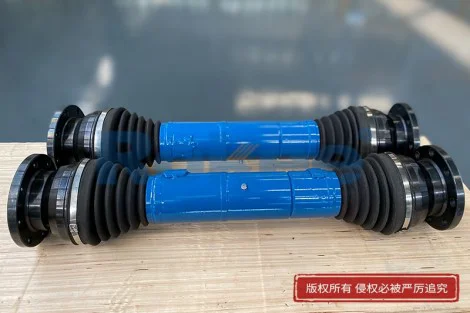
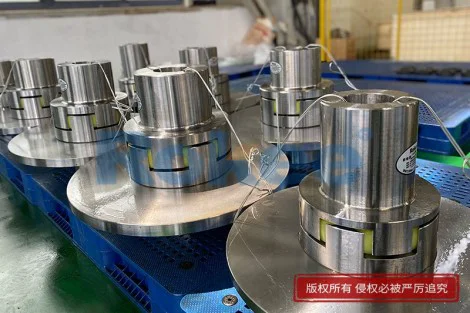
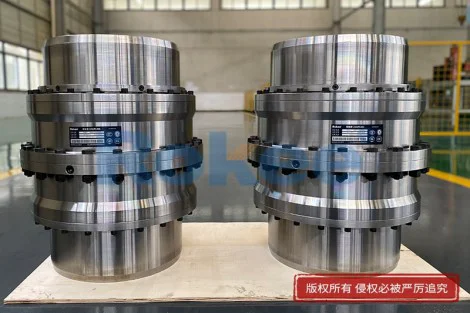
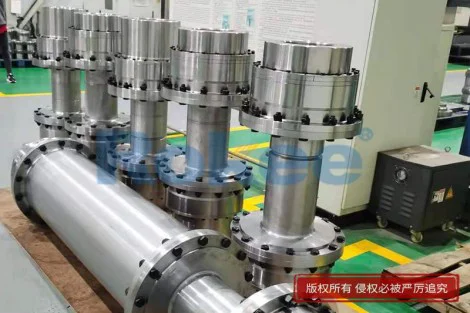
Large Heave-duty Diaphragm Coupling
Large heavy-duty diaphragm couplings are high-performance mechanical transmission components designed to meet the extreme operating requirements of heavy industrial rotating equipment. Distinct from ordinary flexible couplings, these specialized parts adopt reinforced metal diaphragm structures and optimized integral mechanical designs, enabling them to withstand ultra-high torque loads, high-speed rotation, and complex shaft misalignment conditions in harsh industrial scenarios. They primarily serve core industrial equipment including large compressors, turbine units, marine propulsion systems, and heavy industrial pumps, undertaking the critical task of stable torque transmission between driving and driven shafts. Featuring zero clearance transmission, excellent elastic compensation capability, and outstanding fatigue resistance, these couplings effectively reduce mechanical vibration, buffer operational impact, and avoid transmission efficiency loss caused by shaft position deviation. With no lubrication requirements and a compact structural layout, they achieve long-term stable operation while lowering daily maintenance costs, making them an indispensable core component in modern heavy industrial mechanical transmission systems.

The structural design of large heavy-duty diaphragm couplings is the core foundation of their superior heavy-load performance, abandoning the traditional flexible structures of ordinary couplings and adopting an integrated reinforced metal diaphragm group configuration. The main body is composed of high-strength alloy diaphragms, precision-machined hubs, and high-tensile fastening components, with each part optimized for heavy-load and long-cycle operation. Different from single-layer thin diaphragms used in light-duty couplings, heavy-duty models adopt multi-layer stacked thickened diaphragm structures or integral corrugated diaphragm designs, which greatly enhance torsional stiffness and load-bearing capacity without sacrificing elastic flexibility. The hub structure is processed with high-precision forging and finishing technology to ensure uniform force bearing during torque transmission and eliminate local stress concentration. All connecting fasteners are configured with anti-loosening and fatigue-resistant structures to adapt to long-term high-speed rotation and alternating load impact. This holistic structural optimization enables the coupling to maintain complete structural stability under extreme working conditions such as heavy torque, frequent start-stop, and variable load operation, effectively preventing structural deformation and transmission failure that commonly occur in ordinary couplings under heavy loads.
The working principle of large heavy-duty diaphragm couplings relies entirely on the controllable elastic deformation of metal diaphragms to realize power transmission and shaft deviation compensation, achieving pure mechanical flexible transmission without auxiliary media. During equipment operation, the rotational torque generated by the driving shaft is evenly transmitted to the diaphragm group through the driving-end hub and fastening bolts, and then stably transferred to the driven-end hub and the connected driven shaft through the elastic deformation of the diaphragms. When the rotating shafts produce parallel offset, angular deflection, or axial displacement due to equipment installation errors, thermal expansion, or long-term operational wear, the metal diaphragms can absorb and offset these three-dimensional misalignments through tiny elastic bending and stretching deformation. This flexible compensation mode avoids rigid friction and extrusion between shafts, effectively reducing additional mechanical stress on equipment bearings and transmission components. Unlike gear couplings that rely on meshing clearance for deviation compensation, diaphragm couplings achieve zero-clearance torque transmission throughout the operation process, ensuring high transmission accuracy and stable power output even under variable load and high-speed operating conditions.
Large heavy-duty diaphragm couplings exhibit unparalleled performance advantages in harsh industrial operating environments, making them superior to traditional coupling products in adaptability and stability. First of all, their all-metal structural design eliminates the aging, wear and failure problems of rubber and plastic flexible parts, and has excellent resistance to high temperature, low temperature, corrosion and oxidation, adapting to extreme working environments such as high-temperature heat radiation of turbine equipment, low-temperature medium transmission of chemical equipment, and humid and salt-spray marine working conditions. Secondly, the optimized diaphragm structure has ultra-high fatigue resistance, which can withstand millions of times of alternating load impacts and long-term continuous high-speed operation without performance attenuation. In terms of vibration reduction and noise reduction, the elastic deformation characteristics of the diaphragm can effectively absorb mechanical vibration generated by equipment operation and isolate transmission noise, improving the overall operational stability of the unit. In addition, the whole structure has no sliding and meshing friction pairs, so no lubricating oil or grease is required during operation, avoiding equipment pollution and operational failures caused by lubricant deterioration, leakage or failure, and greatly improving the safety and environmental friendliness of industrial production.
The application scenarios of large heavy-duty diaphragm couplings cover almost all heavy industrial fields that require high-precision and high-stability power transmission, showing strong industrial adaptability. In the energy and power industry, they are widely matched with large gas turbines, steam turbines and power generation compressors, providing stable power transmission support for high-power power generation units and ensuring the continuous and efficient operation of power equipment. In the petrochemical industry, they are applied to large centrifugal compressors, process pumps and reaction device transmission systems, adapting to continuous and stable production requirements under complex medium and harsh environmental conditions. In the marine engineering field, these couplings serve large ship propulsion systems and marine power units, resisting hull vibration and water flow impact to ensure reliable power output during ship navigation. In addition, they also play a key role in heavy metallurgical equipment, large wind power units and industrial fan equipment, solving the problems of unstable transmission and easy damage of traditional couplings under heavy-load and long-term operation, and effectively reducing equipment downtime caused by transmission component failure.
In terms of installation, operation and maintenance, large heavy-duty diaphragm couplings have obvious practical advantages, reducing the overall operational cost of industrial equipment. The overall structural layout is compact and reasonable, with standardized component dimensions and simple assembly procedures, which can realize quick installation and disassembly without complex professional tools and lengthy construction processes. During the installation process, the coupling allows a reasonable range of shaft misalignment, which reduces the precision requirement of equipment shaft alignment and lowers the difficulty and time cost of installation and debugging. In daily operation, the all-metal integrated structure has extremely low wear rate and no vulnerable consumable parts, realizing maintenance-free operation for a long time under normal working conditions. Compared with traditional couplings that require regular lubrication, gap adjustment and part replacement, it greatly simplifies daily equipment maintenance work. When equipment needs overhaul and debugging, the split structural design allows quick separation of driving and driven ends, facilitating equipment inspection, maintenance and component replacement, and effectively improving the operational efficiency of industrial production lines.
The performance optimization of large heavy-duty diaphragm couplings has been continuously advanced with the development of industrial manufacturing technology, focusing on material upgrading and structural iteration to adapt to increasingly stringent industrial working conditions. In terms of materials, modern heavy-duty couplings adopt newly developed high-strength alloy materials with higher tensile strength, better fatigue resistance and stronger corrosion resistance than traditional materials, which can maintain stable mechanical properties under ultra-high torque and extreme temperature differences. In structural optimization, finite element analysis technology is used to simulate the force state of the diaphragm under various working conditions, optimize the diaphragm thickness distribution and corrugated shape, further balance the flexibility and torsional stiffness of the coupling, and improve the comprehensive compensation ability of shaft misalignment. At the same time, the fastening structure is upgraded with anti-fatigue and anti-loosening design to avoid bolt loosening and structural displacement caused by long-term vibration. These technological upgrades continuously improve the load capacity, service life and operational stability of the couplings, enabling them to adapt to the development trend of large-scale, high-speed and intelligent modern industrial equipment.
As a key component of heavy industrial mechanical transmission systems, large heavy-duty diaphragm couplings play an irreplaceable role in improving industrial equipment operational efficiency and reducing production costs. Their unique flexible transmission and deviation compensation characteristics solve many pain points of traditional transmission components in heavy-load operation, including easy wear, low precision, frequent maintenance and poor environmental adaptability. With the continuous upgrading of industrial manufacturing standards and the rapid development of high-end equipment manufacturing industry, the market demand for high-performance heavy-duty diaphragm couplings is constantly increasing, and higher requirements are put forward for their load capacity, service life and environmental adaptability. In the future, with the continuous innovation of new materials and structural design technology, large heavy-duty diaphragm couplings will develop towards higher precision, stronger load resistance and longer service life, providing more reliable core support for the stable operation of modern heavy industrial equipment and promoting the high-quality development of industrial mechanical transmission technology.
Tags: Diaphragm Couplings , Single Diaphragm Couplings , Flexible Diaphragm Coupling , pu sandwich panel machine , pu sandwich panel line
« Large Heave-duty Diaphragm Coupling » Update Date: 2026/8/13
Contact
If you require custom machined couplings, please contact Rokee via the contact information below for inquiries.
Email: Rokee@Rokee.com
 WeChat