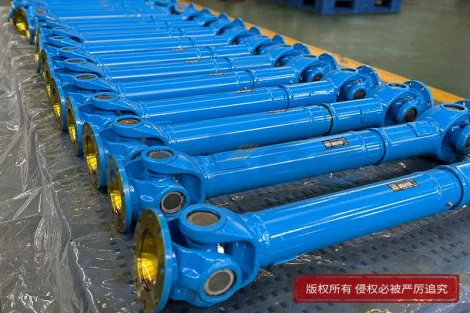
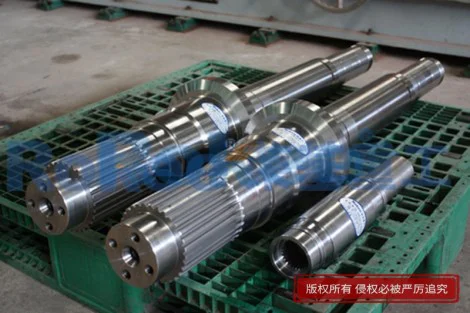
Gear Couplings
Rokee is a manufacturer of gear couplings from china, we can provide non-standard custom gear couplings based on parameters or drawings supplied by customers, with export support available.
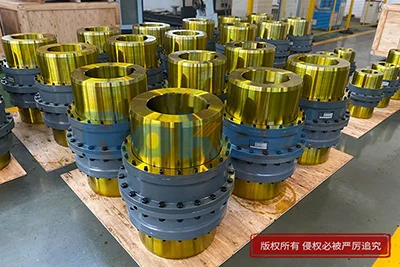
As a core mechanical transmission component in modern industrial systems, gear couplings play an irreplaceable role in connecting rotating shafts and transmitting power across heavy-duty, high-speed, and complex working conditions. Classified as rigid movable couplings, they perfectly combine the high rigidity of rigid transmission parts and the displacement compensation capability of flexible transmission components, breaking the limitations of traditional coupling structures that either lack stability or bear insufficient load capacity. With the continuous upgrading of industrial manufacturing and mechanical equipment towards high power, high precision, and high stability, gear couplings have become a fundamental guarantee for the long-term stable operation of transmission systems in various heavy industries and precision machinery fields, covering almost all mechanical scenarios that require efficient torque transmission and shaft position deviation adaptation.


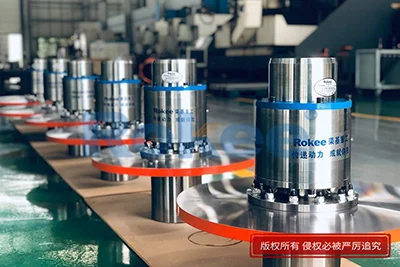
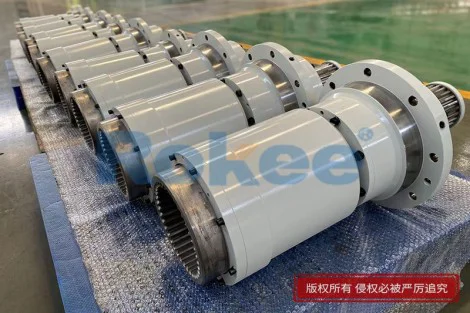
The basic structure of gear couplings follows a concise and scientific mechanical design logic, with internal and external gear meshing as the core functional unit. A complete gear coupling is mainly composed of two external gear hubs and a shared internal gear sleeve. The two external gear hubs are respectively installed on the driving shaft and the driven shaft, while the internal gear sleeve sleeves the outer side of the two external gears to realize mutual meshing transmission. To adapt to the displacement deviation generated during equipment operation, most high-performance gear couplings adopt a crowned tooth profile design for external gears. The tooth surface is processed into a curved structure along the tooth length direction, which enables the gear contact point to be concentrated in the middle of the tooth surface rather than the edge. This optimized structural design effectively avoids local stress concentration and tooth tip wear caused by tiny angular misalignment between shafts, greatly improving the overall operational tolerance of the coupling. Some integrated optimized structures also integrate the gear sleeve and end cover into a whole, which enhances the compactness of the overall structure while ensuring meshing accuracy, reducing assembly gaps, and further improving transmission stability.
The working principle of gear couplings is based on the precise meshing transmission of internal and external gear pairs. In the operating state, the driving shaft drives the external gear hub to rotate, and the torque and rotational motion are stably transmitted to the internal gear sleeve through gear meshing, and then transferred to the external gear hub on the driven shaft, thereby realizing the synchronous rotation and power transmission of the two connected shafts. Different from fixed rigid couplings that require absolute coaxiality of shafts and elastic couplings that rely on material deformation for buffering, gear couplings utilize the matching gap between internal and external gear teeth and the flexibility of crowned tooth contact to achieve multi-dimensional displacement compensation. During the long-term operation of mechanical equipment, installation errors, equipment foundation settlement, component thermal deformation under high temperature, and mechanical vibration will inevitably lead to axial, radial, and angular relative displacement between the driving and driven shafts. The unique gear meshing structure of gear couplings can effectively adapt to these deviations, avoid additional bending stress and friction loss caused by shaft misalignment, and protect the transmission shaft system, bearings, and other core components from abnormal damage.
The excellent comprehensive performance of gear couplings makes them stand out among various coupling types, with prominent advantages in load capacity, transmission efficiency, environmental adaptability, and service stability. First of all, due to the multi-tooth meshing transmission mode, gear couplings can bear large torque and heavy impact loads, and their load-bearing capacity is far higher than that of diaphragm couplings, spring couplings and other flexible couplings of the same volume. This characteristic makes them the preferred transmission component for heavy-load mechanical equipment. Secondly, the overall rigidity of the gear meshing structure is high, with almost no elastic deformation during operation, ensuring extremely high transmission accuracy and synchronous rotation efficiency, which can meet the precise transmission requirements of high-speed and high-precision mechanical systems. In addition, gear couplings have outstanding environmental adaptability, capable of stable operation in extreme temperature environments ranging from minus 40 degrees Celsius to 200 degrees Celsius, and can resist adverse factors such as high dust, humid corrosion, and strong mechanical impact in industrial scenarios. Compared with other coupling products, their service life is longer under harsh working conditions, effectively reducing the frequency of equipment maintenance and component replacement.
In terms of functional characteristics, the multi-dimensional displacement compensation capability of gear couplings is one of their most core competitive advantages. The special tooth profile and structural gap design can simultaneously compensate axial displacement generated by thermal expansion and contraction of components, radial displacement caused by equipment vibration and installation offset, and angular displacement formed by shaft deflection. This comprehensive compensation performance solves the common pain points of traditional transmission systems, such as easy vibration, loud noise, fast component wear, and low transmission efficiency caused by shaft misalignment. At the same time, the gear coupling has a compact overall structure and small axial and radial size, which can save installation space for mechanical equipment and is convenient for integrated design and assembly of complex mechanical systems. Its simple transmission principle and stable structural performance also endow it with low failure rate and strong operational reliability, which is crucial for industrial production scenarios that require continuous and uninterrupted operation.
Gear couplings have a wide range of industrial application scenarios, covering core fields of heavy industry, new energy, mining, metallurgy, and precision machinery. In the metallurgical industry, which is a traditional dominant application field, gear couplings are widely used in the main transmission systems of rolling mills, smelting equipment, and cooling conveying equipment. Metallurgical equipment often operates under long-term heavy load and frequent impact conditions, and the high torque resistance and impact resistance of gear couplings can fully adapt to the harsh working environment, ensuring the stable operation of rolling and smelting production lines for a long time. In the new energy wind power industry, large-specification gear couplings are applied to the connection of wind turbine gearboxes and transmission shafts, adapting to the random vibration, variable load impact and temperature difference changes in wind field operation, and providing reliable power transmission guarantee for wind power generation equipment.
In the mining and engineering machinery industry, gear couplings are used in core equipment such as crushers, conveyors, excavators and hoists. Mining equipment usually works in high-dust and high-vibration environments with complex and variable loads. The strong environmental adaptability and load resistance of gear couplings can effectively cope with harsh working conditions and reduce equipment failure downtime. In the field of high-speed transportation and precision manufacturing, gear couplings are applied to the transmission systems of high-speed mechanical equipment, machine tool transmission shafts, and automated production equipment. Their high transmission accuracy and low vibration characteristics ensure the operating precision of precision machinery and meet the stringent requirements of modern precision manufacturing for transmission stability. In addition, they also play an important role in petrochemical transmission equipment, power generation equipment, and port handling machinery, becoming a universal core component supporting the operation of modern industrial mechanical systems.
Although gear couplings have excellent inherent performance, their long-term stable operation is inseparable from standardized processing and manufacturing, scientific installation and daily maintenance. In the manufacturing process, the machining accuracy of gear tooth profile, tooth surface roughness and meshing gap directly determine the transmission performance and service life of the coupling. High-precision grinding and heat treatment processes are usually adopted to improve the hardness, wear resistance and fatigue resistance of the gear surface, avoiding tooth surface pitting, wear and tooth breakage failure caused by long-term meshing friction. At the same time, the overall structural symmetry and dimensional accuracy of the coupling are strictly controlled to ensure dynamic balance during high-speed operation and reduce operating vibration and noise.
Installation accuracy is a key link affecting the service effect of gear couplings. Although the product itself has displacement compensation capability, excessive installation deviation will still increase the meshing friction of gear teeth, lead to accelerated wear, and even cause abnormal vibration of the transmission system. Therefore, in the installation process, it is necessary to strictly calibrate the coaxiality of the driving and driven shafts, control the axial, radial and angular deviation within the allowable range of the product design, and ensure the uniform meshing of internal and external gear teeth. In terms of daily maintenance, lubrication management is particularly important. Good lubrication can form a protective oil film on the gear meshing surface, reduce friction and wear, dissipate operating heat, and avoid tooth surface ablation and aging failure caused by high-temperature friction. For couplings operating in harsh environments, regular cleaning of dust and impurities inside the gear sleeve and regular replacement of lubricating grease are required to maintain optimal transmission performance.
With the rapid development of modern industrial technology and the continuous improvement of industrial equipment's requirements for transmission performance, the technical upgrading of gear couplings is also accelerating. At present, the industry is developing towards high precision, high durability, lightweight and intelligent adaptation. On the basis of maintaining high load capacity, new generation gear couplings adopt optimized tooth profile design and high-performance alloy materials, which further reduce structural weight and operating vibration while improving wear resistance and fatigue resistance. At the same time, with the popularization of intelligent manufacturing technology, some optimized gear coupling products are combined with vibration and temperature monitoring structures, which can real-time monitor the operating state of the transmission system, realize early warning of abnormal wear and failure, and improve the intelligent operation and maintenance level of equipment.
In the context of the continuous upgrading of global industrial manufacturing, the importance of gear couplings in mechanical transmission systems will be further highlighted. As a basic mechanical component integrating high rigidity, high efficiency and high adaptability, it can perfectly match the development trend of modern equipment towards high power, high precision and long-life operation. In the future, with the continuous innovation of material technology, processing technology and intelligent monitoring technology, the comprehensive performance of gear couplings will be further improved, their application scope will be more extensive, and they will continue to provide stable and reliable basic support for the efficient operation of various industrial mechanical equipment. For industrial mechanical design and equipment operation and maintenance, a full understanding of the performance characteristics, application scope and maintenance points of gear couplings is of great significance to optimizing the design of transmission systems, reducing equipment operating costs, and improving the overall operational efficiency and stability of mechanical equipment.
« Gear Couplings » Update Date: 2026/7/15
Contact
If you require custom machined couplings, please contact Rokee via the contact information below for inquiries.
Email: Rokee@Rokee.com
 WeChat