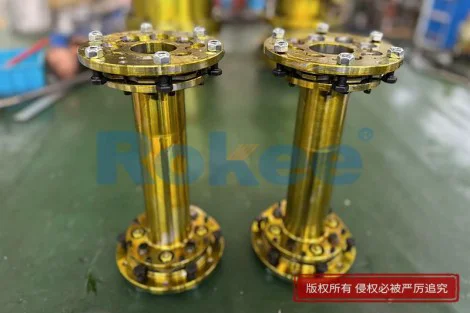
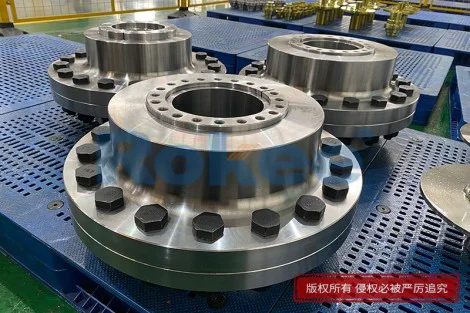
Universal Couplings
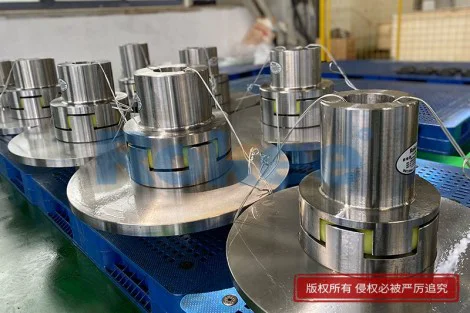
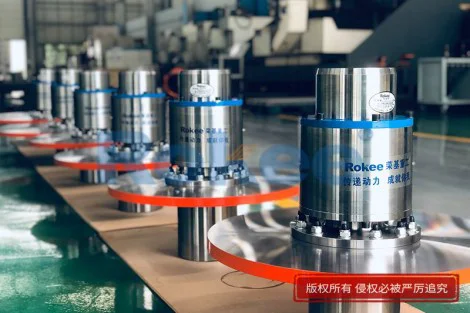
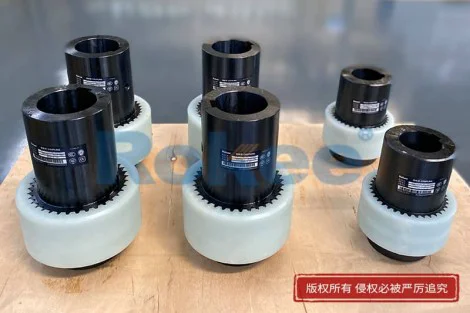
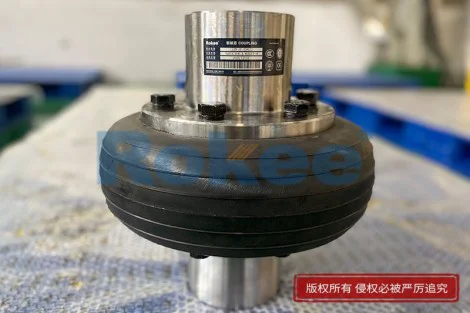
Rokee is a manufacturer of universal couplings from china, we can provide non-standard custom universal couplings based on parameters or drawings supplied by customers, with export support available.

In the intricate and interconnected ecosystem of modern mechanical transmission systems, the stable transfer of power and rotational motion serves as the fundamental guarantee for the normal operation of all mechanical equipment. Every rotating component and transmission link in machinery faces unavoidable challenges in actual operation, including assembly deviations, structural deformation under load, thermal expansion and contraction caused by long-term operation, and dynamic position changes of equipment components. These objective factors lead to the fact that the rotating shafts responsible for power output and input can rarely maintain absolute collinearity and fixed positional relationships. In this context, rigid transmission components that rely on precise axis alignment are no longer sufficient to adapt to complex working conditions, and flexible transmission components represented by universal couplings have become indispensable core parts of mechanical transmission systems. As a classic and highly versatile mechanical connecting component, the universal coupling has broken through the limitations of traditional shaft connection structures, realizing efficient, stable and reliable torque and motion transmission between two shafts with angular deviation, parallel displacement and dynamic position changes, and has been widely applied in almost all fields involving mechanical power transmission.
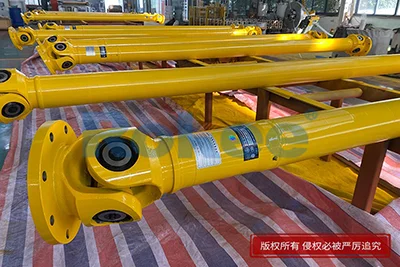
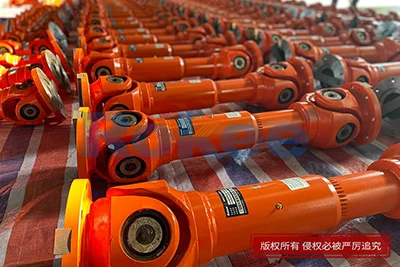

Also commonly known as universal joint or Cardan joint in mechanical engineering academia and industrial practice, the universal coupling is a specialized transmission component designed for non-collinear shaft connection. Its core design concept is to use a flexible hinged structure to decouple the rigid constraint between transmission shafts, so that the equipment can still maintain continuous and efficient power transmission when the relative position of the driving shaft and the driven shaft changes dynamically. Different from rigid couplings that require high-precision coaxial installation and elastic couplings that only allow tiny displacement compensation, the universal coupling has outstanding angular compensation capability, which can adapt to large-angle deflection between shafts while retaining stable torque transmission performance. This unique functional advantage makes it fill the technical gap in medium and large deviation power transmission, becoming a key link to solve the problem of power transmission under complex installation and operating conditions.
The basic working principle of the universal coupling is derived from the mechanical motion characteristics of its core hinged structure. The mainstream universal coupling structure is composed of two symmetric yokes and a central cross shaft trunnion, forming a double-hinged flexible connection system. The cross shaft acts as the core force-bearing and motion-conducting component, connecting the driving yoke and the driven yoke respectively. When the driving shaft rotates, the torque is transmitted to the cross shaft through the driving yoke, and then the cross shaft drives the driven yoke and the connected driven shaft to rotate synchronously. In this process, the hinged fit between the cross shaft and the yokes allows free rotation within a certain angular range, enabling the coupling to adapt to the angular inclination between the two shafts. A single universal coupling can achieve stable power transmission under a certain angle deviation, while the combined application of two or more universal couplings can further offset the periodic speed fluctuation of a single joint, realizing constant-speed and smooth power transmission, which greatly improves the stability of the entire transmission system.
The structural characteristics of universal couplings determine their excellent comprehensive mechanical properties and environmental adaptability. First of all, they have excellent angular compensation performance, which can effectively adapt to the axis deflection caused by equipment installation errors, structural vibration and thermal deformation. In actual industrial production, the installation of mechanical shafts inevitably has tiny deviations, and long-term high-load operation will cause slight deformation of equipment frames and transmission components. The flexible structure of universal couplings can fully absorb these deviations and deformations, avoiding additional stress concentration on the transmission shaft, bearings and equipment shell, and effectively reducing the wear and failure rate of key components. Secondly, universal couplings have strong load-bearing capacity and transmission efficiency. Made of high-strength alloy materials through precision forging and heat treatment, the core components can withstand large torque and impact load, maintaining high transmission efficiency in long-term continuous operation without obvious power loss.
In addition to angular compensation, high load resistance and high efficiency transmission, universal couplings also have good axial and radial displacement compensation capabilities. The optimized structural design allows the connected shafts to produce a certain range of axial telescopic displacement and radial offset displacement during operation, which can adapt to the positional changes of components caused by equipment vibration, mechanical movement and thermal expansion. This multi-dimensional displacement compensation function is incomparable to many traditional transmission couplings. Moreover, the overall structure of the universal coupling is compact and reasonable, with small occupied space and flexible installation form, which can adapt to various complex installation spaces and structural layouts of mechanical equipment. It has strong environmental adaptability, can operate stably in high temperature, low temperature, dust, humidity and other harsh working environments, and is not easy to be damaged by external environmental interference, ensuring the long-term stable operation of mechanical equipment.
With the continuous development of mechanical engineering technology and the continuous expansion of industrial application scenarios, universal couplings have derived a variety of structural forms to adapt to different working conditions, forming a complete product system covering light-load precision transmission and heavy-load industrial transmission. Ordinary cross-shaft universal couplings are the most widely used basic type, with simple structure, low manufacturing cost and stable performance, suitable for conventional mechanical transmission scenarios with medium and low load and ordinary operating environment. For heavy-duty industrial equipment such as metallurgical rolling machinery, mining machinery and engineering machinery, enhanced heavy-duty universal couplings are adopted, with optimized cross shaft and yoke structure and thickened force-bearing parts, which can withstand ultra-large torque and frequent impact loads, adapting to high-intensity continuous operating conditions.
In the field of high-precision mechanical transmission such as aerospace equipment, precision instrumentation and automated production equipment, precision universal couplings are widely used. This type of coupling adopts ultra-precision processing technology and high-precision matching structure, which can eliminate transmission clearance, ensure synchronous and accurate transmission of motion and torque, and meet the high-precision operation requirements of precision equipment. In addition, telescopic universal couplings with axial displacement compensation function are specially designed for mechanical equipment with frequent axial position changes of transmission shafts. The spline telescopic structure inside the coupling can realize free axial stretching while ensuring torque transmission, effectively solving the power transmission problem of dynamically displaced shafts. The diversified structural forms enable universal couplings to cover almost all mechanical transmission scenarios, from civilian light machinery to heavy industrial equipment, from conventional industrial production to high-end precision manufacturing.
The industrial application value of universal couplings is fully reflected in multiple industrial fields, becoming an important basic component to support the normal operation of modern industrial systems. In the automotive industry, universal couplings are the core components of vehicle transmission systems, applied to the drive shaft structure of passenger cars, commercial vehicles and engineering vehicles. During the driving process of the vehicle, the up and down jitter of the chassis and the deformation of the vehicle body will cause real-time changes in the relative position of the engine output shaft and the drive axle. The universal coupling can adapt to this dynamic angular and positional change, stably transmitting power to the drive wheels and ensuring the smooth driving of the vehicle. Without the flexible compensation function of universal couplings, the vehicle transmission system will be prone to rigid impact, severe vibration and accelerated wear, which will seriously affect driving stability and service life.
In the field of engineering machinery and construction equipment, universal couplings undertake the power transmission task of various mobile and operating mechanisms. Equipment such as excavators, cranes, loaders and road rollers often work in complex and harsh working conditions, with large equipment vibration, frequent load changes and severe structural deformation. The high load-bearing capacity and excellent displacement compensation performance of universal couplings can adapt to the harsh operating environment, ensuring continuous and stable power output of hydraulic systems, walking mechanisms and operating arms, and improving the operational reliability and durability of engineering machinery. In metallurgical, chemical and papermaking industrial equipment, various rotating machinery needs to operate continuously for a long time, and the thermal deformation of equipment components caused by long-term high-temperature operation is obvious. Universal couplings can effectively compensate for the axis deviation caused by thermal deformation, avoid transmission system failure caused by shaft jamming and stress concentration, and ensure the long-term stable operation of continuous production lines.
In agricultural machinery, ship equipment, railway locomotives and other fields, universal couplings also play an irreplaceable role. Agricultural machinery such as tractors and harvesters usually works in uneven field roads, with severe equipment vibration and complex working condition changes. Universal couplings can adapt to frequent shaft position changes and ensure stable power transmission of walking and operating systems. Ship power transmission systems need to face the impact of hull shaking and water flow fluctuation, and the flexible structure of universal couplings can buffer vibration and impact, protecting the ship's power transmission components. Railway locomotives and rail transit equipment also rely on universal couplings to realize stable power transmission between power components and walking mechanisms, adapting to the vibration and displacement changes during vehicle operation.
In addition to basic power transmission functions, universal couplings also play an important role in improving the dynamic performance of mechanical systems and reducing equipment operation costs. In the operation of mechanical equipment, rigid transmission structures will produce severe vibration and impact when the shaft axis is deviated, leading to increased equipment noise, accelerated component wear, and even fatigue failure of transmission shafts and bearings. The flexible hinged structure of universal couplings can effectively buffer and absorb vibration and impact in the transmission process, reduce the vibration amplitude of the transmission system, lower equipment operating noise, and improve the overall operating stability of the equipment. At the same time, it avoids the additional load and stress wear caused by shaft misalignment, greatly reduces the failure rate of transmission components, extends the service life of equipment, and reduces equipment maintenance costs and downtime losses for industrial production.
Scientific selection and standardized maintenance are key factors to ensure the long-term stable operation of universal couplings and give full play to their performance advantages. In the selection process, it is necessary to comprehensively consider multiple factors such as equipment operating load, rotating speed, working environment, displacement compensation demand and transmission accuracy requirements. For heavy-load and high-impact working conditions, priority should be given to high-strength heavy-duty universal couplings with good impact resistance and load-bearing performance. For high-precision transmission equipment, precision gap-free universal couplings need to be selected to ensure motion synchronization and transmission accuracy. For equipment with large axial displacement, telescopic structural forms should be matched to meet the dynamic displacement compensation demand. Blind selection of models not matching the working conditions will lead to insufficient coupling performance, accelerated wear and even early failure, affecting the normal operation of the entire mechanical system.
Daily maintenance and inspection work is crucial to the service life and operating stability of universal couplings. In the daily operation of equipment, regular inspection of the coupling's operating state is required, including checking for abnormal vibration, abnormal noise and loose connection during operation. The core hinged parts and bearing parts of universal couplings need regular lubrication maintenance. Good lubrication can reduce friction and wear of moving parts, reduce operating temperature, and avoid component abrasion and fatigue damage caused by dry friction. For equipment operating in dusty, humid and corrosive environments, it is necessary to do a good job in the sealing protection of couplings to prevent external impurities from entering the hinge gap and causing jamming and wear. At the same time, the aging and wear of coupling components should be regularly checked, and worn parts should be replaced in a timely manner to avoid hidden dangers of equipment operation caused by component failure.
With the continuous progress of material science, manufacturing technology and intelligent manufacturing technology, universal coupling technology is also constantly innovating and upgrading, showing new development trends in performance optimization, structural innovation and application expansion. In terms of materials, traditional carbon steel and alloy steel materials are gradually optimized and upgraded, and high-strength, wear-resistant, corrosion-resistant and high-temperature resistant new alloy materials and composite materials are increasingly applied to the manufacturing of universal couplings. The application of new materials further improves the mechanical strength, wear resistance and environmental adaptability of couplings, enabling them to adapt to more extreme working conditions such as ultra-high temperature, ultra-low temperature and strong corrosion.
In terms of structural design, with the help of computer simulation analysis and finite element optimization technology, the structural form of universal couplings is continuously optimized. The optimized force-bearing structure reduces stress concentration, improves material utilization and structural stability, and further improves the load-bearing capacity and fatigue resistance of products. At the same time, integrated and lightweight structural design has become an important development direction. On the premise of ensuring mechanical performance, reducing the overall weight and volume of couplings helps reduce the overall weight of mechanical equipment, reduce equipment operating energy consumption, and improve equipment operating efficiency. In addition, the modular design of universal couplings realizes the standardized production and rapid assembly of components, which is convenient for equipment installation, maintenance and later replacement, and improves the practicality and economy of products.
In the context of intelligent industrial development, the intelligent upgrading of universal couplings has become an emerging development trend. By embedding sensing components, the operating parameters such as operating temperature, vibration amplitude, torque load and wear state of couplings can be monitored in real time. The real-time operating data is transmitted to the equipment control system, realizing online monitoring, fault early warning and predictive maintenance of couplings. This intelligent monitoring mode changes the traditional passive maintenance mode of regular inspection and post-fault maintenance, effectively avoids sudden equipment failure caused by coupling damage, improves the intelligent operation level of mechanical equipment, and provides strong support for the stable and efficient operation of intelligent production lines.
As a classic and evolving basic mechanical component, the universal coupling has always been adhering to the design concept of adapting to complex working conditions and optimizing transmission performance, and has become an indispensable key part of modern mechanical transmission systems. Its unique multi-dimensional displacement compensation capability, stable high-efficiency transmission performance, strong environmental adaptability and diversified structural forms enable it to solve various difficult problems in power transmission under complex working conditions, providing reliable technical support for the normal operation of various mechanical equipment. From traditional industrial manufacturing to emerging intelligent equipment, from civilian mechanical products to high-end industrial equipment, the application value of universal couplings is constantly highlighted and expanded.
In the future, with the continuous upgrading of industrial manufacturing level and the continuous emergence of new mechanical equipment and new working conditions, the performance requirements for universal couplings will be further improved. The continuous innovation of material technology, structural design and intelligent technology will further promote the iterative upgrading of universal coupling products, making their performance more excellent, structure more optimized and application more extensive. As an important basic component supporting the development of the machinery industry, universal couplings will continue to play an irreplaceable role in the development of modern industry, providing solid basic support for the high-quality development of mechanical engineering and industrial manufacturing fields.
« Universal Couplings » Update Date: 2026/7/15
Contact
If you require custom machined couplings, please contact Rokee via the contact information below for inquiries.
Email: Rokee@Rokee.com
 WeChat