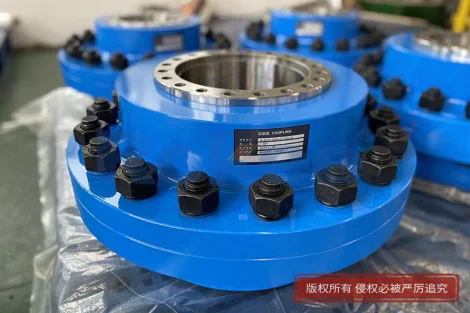
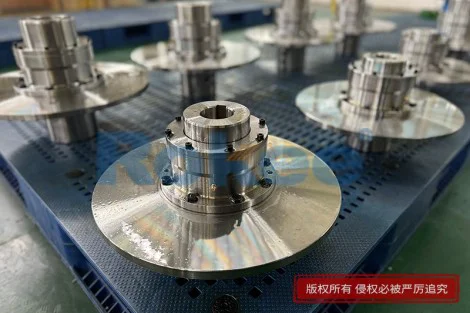
Barrel Couplings
Rokee is a manufacturer of barrel couplings from china, we can provide non-standard custom barrel couplings based on parameters or drawings supplied by customers, with export support available.

In the field of mechanical transmission systems, coupling components serve as the core connecting medium between power sources and executing mechanisms, undertaking the critical tasks of torque transmission, motion coordination and equipment operation protection. Among various coupling types, barrel coupling stands out as a high-performance flexible transmission component tailored for heavy-duty and complex operating conditions. Different from traditional rigid couplings with single transmission logic and ordinary elastic couplings with limited load capacity, barrel coupling integrates rolling contact transmission, multi-dimensional misalignment compensation and high-load bearing performance, making it widely applicable in heavy machinery, material handling, industrial transmission and other core industrial scenarios. It effectively solves common operational problems such as shaft misalignment, impact load vibration and local stress concentration in mechanical transmission, and greatly improves the stability and service life of the entire transmission system.


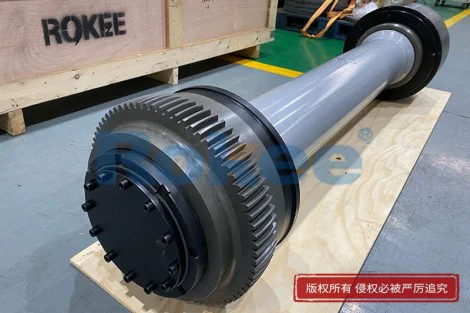
The basic structural composition of barrel coupling follows a refined and practical mechanical design logic, with each component cooperating precisely to complete efficient power transmission. The whole structure is mainly composed of flanged sleeve, toothed hub, hardened steel barrel rollers and integrated sealing components. The inner wall of the flanged sleeve is processed with uniform semicircular tooth grooves, while the outer circumference of the matching hub is equipped with corresponding curved tooth structures. A certain number of cylindrical barrel rollers made of high-strength hardened steel are embedded in the closed tooth grooves formed by the sleeve and the hub. These barrel rollers are the key force-bearing and transmission components of the coupling, differing from the straight pin structure of conventional pin couplings. The curved contact matching mode between the barrel rollers and the tooth grooves realizes surface contact force transmission, which fundamentally optimizes the stress state of the transmission structure. Meanwhile, the external matching sealing cover and special sealing accessories form a fully closed internal working space, which can effectively isolate external dust, moisture and corrosive media, and prevent internal lubricating grease from overflowing, ensuring long-term stable operation of internal moving parts.
The working principle of barrel coupling is based on the coordinated operation of compressive force transfer and rolling contact motion, forming a smooth and impact-free torque transmission mechanism. When the mechanical equipment starts running, the driving shaft drives the hub to rotate synchronously, and the rotational torque generated by the power system is stably transmitted to the barrel rollers through the contact surface of the hub’s outer curved teeth. Driven by the torque, the barrel rollers roll along the semicircular tooth grooves of the outer sleeve, and further transmit the rotational power to the flanged sleeve and the connected driven shaft, realizing the synchronous rotation of the two shafts and the continuous output of mechanical power. In the whole transmission process, the rolling friction mode replaces the sliding friction of traditional couplings, which not only reduces the friction loss in power transmission and improves transmission efficiency, but also avoids rigid collision and mechanical impact between components. This flexible transmission mode enables the coupling to adapt to the dynamic operation state of equipment and maintain stable power output even in variable load working conditions.
One of the core advantages of barrel coupling is its excellent multi-dimensional misalignment compensation capability, which can adapt to the installation errors and operational deformation of mechanical shafts in actual industrial scenarios. In the assembly and operation of mechanical equipment, it is difficult to achieve absolute coaxiality between the driving shaft and the driven shaft. Minor axial displacement, radial deviation and angular deflection are inevitable due to processing errors, assembly gaps, equipment vibration and thermal deformation during operation. Ordinary rigid couplings cannot adapt to these misalignment states, which will cause additional bending stress and shear stress on the shaft body, leading to shaft deformation, component wear and even equipment failure in the long run. As a flexible transmission component, barrel coupling relies on the movable matching gap between the barrel rollers and the curved tooth grooves, which can automatically compensate for axial, radial and angular misalignments within the allowable range during operation. This self-compensation function eliminates additional mechanical stress caused by shaft misalignment, protects the shaft, bearing and other key components of the transmission system, and reduces the failure rate of equipment operation.
In terms of load-bearing performance, barrel coupling has outstanding heavy-load resistance and impact resistance, which is the key reason for its wide application in heavy industrial equipment. Benefiting from the optimized curved tooth surface structure and surface contact transmission mode, the stress distribution on each contact tooth surface and barrel roller is extremely uniform during torque transmission. There is no local stress concentration or excessive pressure on individual components, which effectively avoids fatigue damage and local wear of parts under long-term load operation. This uniform force-bearing characteristic enables the coupling to stably transmit large torque for a long time, and can withstand instantaneous impact load and short-term overload working conditions that often occur in industrial production. Compared with elastic couplings that rely on elastic deformation to buffer load and have limited bearing capacity, barrel coupling adopts all-metal rigid force-bearing components, which have higher structural rigidity and load tolerance. Compared with ordinary gear couplings, its rolling contact structure reduces meshing wear and noise, and has better dynamic load adaptability.
The structural design of barrel coupling also takes into account the practical needs of industrial installation and maintenance, with excellent structural practicability and operational convenience. The overall structure is compact and reasonable, with small axial installation space occupation, which is very suitable for mechanical equipment with limited internal installation space. The integrated flange structure simplifies the assembly process, and the butt joint and fixation between the coupling and the shaft can be completed through conventional clamping and connecting modes, without complex assembly steps and special installation tools. In terms of disassembly and maintenance, the closed sealing structure is convenient for daily inspection and grease replacement. The internal barrel rollers and tooth groove structures have strong wear resistance, and the regular maintenance cycle is longer than that of ordinary couplings. The standardized structural design makes the replacement of vulnerable parts more convenient, which greatly reduces the daily maintenance cost and equipment downtime caused by component replacement. In addition, the axial free movement characteristic of the coupling can effectively adapt to the thermal expansion and cold contraction deformation of the shaft during long-term operation, avoiding structural jamming and additional axial pressure caused by temperature changes.
Barrel coupling has extremely high application pertinence in industrial scenarios with complex working conditions and high operational stability requirements, and its application scope covers multiple core industrial fields. In material handling and lifting machinery, it is often used to connect the output shaft of the reducer and the winding drum of lifting equipment. In crane operation, the equipment often bears variable loads, start-stop impacts and frequent steering operations, and the shaft system is prone to misalignment and vibration. The barrel coupling can stably transmit large torque, buffer operating vibration, compensate for shaft misalignment, and ensure the accurate and stable operation of the lifting drum. At the same time, it can bear certain radial load while transmitting torque, which optimizes the stress state of the three-point bearing structure of lifting equipment and avoids statically indeterminate stress problems in rigid connection structures.
In industrial transmission systems such as conveyor equipment and lifting platforms, barrel coupling also shows excellent adaptive performance. Conveyor equipment needs continuous and stable power output for a long time, and will be affected by material load fluctuation and equipment operation vibration during operation. The efficient and low-loss transmission performance of barrel coupling ensures the stability of power transmission of the conveyor, and its good wear resistance adapts to long-term continuous operation. Lifting platform equipment puts forward high requirements on the safety and accuracy of the transmission system. The misalignment compensation and impact resistance of barrel coupling can eliminate the transmission error caused by shaft deformation and vibration, ensure the precise positioning and stable lifting of the platform, and improve the operational safety of the equipment. In addition, in heavy-duty transmission equipment such as industrial winches and mining transmission devices, barrel coupling can cope with harsh working environments such as heavy dust, variable load and frequent start-stop, relying on its closed anti-pollution structure and high load-bearing performance.
In terms of operational stability and service life, barrel coupling has obvious comprehensive advantages over traditional coupling products. The all-metal wear-resistant structure and rolling contact transmission mode greatly reduce the wear rate of components. The uniform stress distribution avoids fatigue cracks and structural deformation caused by long-term uneven force. The fully closed sealing system can effectively block the erosion of external corrosive media and abrasive particles, prevent internal lubricant deterioration and failure, and maintain a good internal lubrication state for a long time. Good lubrication and low-wear operation environment make the service life of barrel coupling far longer than that of ordinary elastic couplings and pin couplings under the same working conditions. At the same time, the torsionally rigid transmission characteristic ensures no obvious torsion deformation during torque transmission, which guarantees the synchronization and accuracy of power transmission, avoids transmission efficiency loss and motion error caused by elastic deformation, and meets the high-precision transmission requirements of industrial equipment.
In actual industrial operation, the correct selection and standardized use of barrel coupling are crucial to giving full play to its performance advantages. The selection process needs to comprehensively consider the equipment’s operating load, torque demand, shaft misalignment range, operating frequency and environmental conditions. For heavy-load and frequent start-stop equipment, the load margin and impact resistance of the coupling should be fully reserved; for equipment with large shaft installation errors or easy thermal deformation, the misalignment compensation performance of the coupling should be focused on. In the installation process, the coaxiality of the two shafts should be adjusted as far as possible within the allowable compensation range of the coupling to avoid excessive misalignment leading to accelerated component wear. Daily maintenance mainly focuses on the sealing state and internal lubrication. Regular inspection of the sealing integrity and timely replacement of deteriorated lubricating grease can effectively maintain the working performance of the coupling and extend its service life.
With the continuous upgrading of industrial machinery towards high efficiency, high stability and long service life, the market demand for high-performance transmission components is increasing day by day. As a professional heavy-duty flexible coupling, barrel coupling perfectly adapts to the development trend of modern industrial equipment. Its integration of high torque transmission capacity, multi-dimensional misalignment compensation, vibration buffering and low maintenance characteristics makes it an indispensable core component in heavy machinery transmission systems. Compared with traditional coupling products, it solves many pain points in industrial transmission, such as easy wear of components, poor impact resistance, limited compensation capacity and frequent maintenance. In the future, with the continuous optimization of structural design and material technology, the comprehensive performance of barrel coupling will be further improved, and its application scope in high-end equipment manufacturing, intelligent logistics transmission, heavy engineering machinery and other fields will be more extensive, providing more reliable basic support for the stable operation of modern industrial transmission systems.
« Barrel Couplings » Update Date: 2026/7/15
Contact
If you require custom machined couplings, please contact Rokee via the contact information below for inquiries.
Email: Rokee@Rokee.com
 WeChat