Types of Cardan Couplings
Cardan couplings, also widely recognized as universal joints, are fundamental mechanical transmission components designed to transfer rotational torque and motion between two shafts that are not perfectly collinear. They accommodate angular misalignment, axial displacement, and minor radial offset during equipment operation, making them indispensable in a vast range of mechanical transmission systems. With the continuous advancement of mechanical manufacturing technology and the diversification of industrial working conditions, cardan couplings have evolved into multiple structural types with distinct performance characteristics. Each variant is optimized for specific speed ranges, torque loads, misalignment tolerances, and operational environments, laying a solid foundation for stable and efficient power transmission in complex mechanical systems. Understanding the classification, structural features, working mechanisms, and application advantages of different cardan coupling types is essential for reasonable component selection, equipment performance optimization, and extended mechanical service life.

The most basic and original classification of cardan couplings is the single cardan coupling, which represents the simplest structural form of universal joint transmission. A typical single cardan coupling consists of two yoke-shaped shaft ends and a central cross-shaped spindle, with bearing assemblies installed at the four ends of the cross spindle to reduce friction during relative rotation. The core structural feature of this type is the independent single-joint transmission structure, which enables the two connected shafts to form a certain angular deflection during operation. The cross spindle can freely rotate within the range of the yoke limit, realizing flexible torque transmission under angular misalignment conditions. Despite its simple structure, small size, and low installation space requirements, the single cardan coupling has an inherent mechanical characteristic of periodic velocity fluctuation during operation. When the input shaft rotates at a constant speed, the output shaft produces regular speed changes within a single rotation cycle, and the amplitude of this velocity fluctuation increases with the growth of the shaft deflection angle. This periodic motion deviation will generate torsional vibration, alternating stress, and dynamic load impact on the transmission system, which limits its application scenarios. In practical applications, single cardan couplings are mostly used in low-speed, light-load, and intermittent working conditions where transmission stability requirements are not stringent, such as small mechanical auxiliary transmission mechanisms and low-power rotating equipment. Their outstanding advantages lie in simple manufacturing process, convenient assembly and disassembly, and strong adaptability to simple misalignment environments, providing economical and reliable transmission solutions for basic mechanical systems.
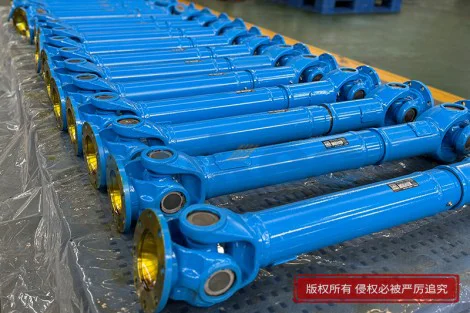
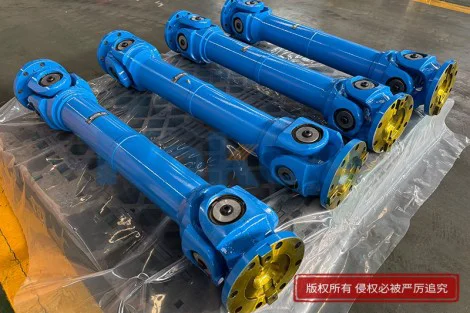
To overcome the velocity fluctuation defect of single cardan couplings, the double cardan coupling has become the most widely used structural type in industrial transmission fields. This type of coupling is formed by connecting two single cardan joints in series through an intermediate shaft, with the two universal joints installed in a 90-degree phase difference state. The ingenious structural design realizes the mutual offset of the velocity fluctuations generated by the two single joints. When one joint produces a deceleration trend, the other joint generates a corresponding acceleration trend, thus ensuring that the input shaft and output shaft maintain a nearly constant instantaneous angular velocity during the entire rotation process. The intermediate shaft connecting the two joints can be designed as solid or hollow according to actual working requirements. Solid intermediate shafts have high structural rigidity and excellent load-bearing capacity, suitable for high-torque transmission scenarios that require strong structural stability. Hollow intermediate shafts effectively reduce the overall weight and rotational inertia of the coupling, which is more conducive to high-speed rotating operation and can reduce the dynamic energy consumption of the transmission system. Compared with single cardan couplings, double cardan couplings significantly improve transmission stability, greatly reduce vibration, noise, and alternating load impact during operation, and allow a larger angular misalignment range between shafts. This type of coupling can adapt to continuous and stable transmission working conditions and is widely applied in medium and large mechanical equipment that requires high transmission accuracy and operational stability. Whether it is medium-speed and high-torque industrial transmission equipment or mechanical systems with long-term continuous operation, double cardan couplings can maintain reliable working performance and effectively extend the service life of the entire transmission system.
With the upgrading of high-speed and high-precision mechanical equipment, constant-velocity cardan couplings have been developed and popularized as a specialized variant, among which the ball cage cardan coupling is the most representative. Different from the traditional cross-shaft structure, the ball cage cardan coupling adopts spherical raceways and high-precision steel balls as the core transmission components. The inner and outer raceways with precise curved structures and evenly distributed steel balls form a symmetric transmission structure. Relying on accurate geometric matching and motion coordination, this structure ensures that the input shaft and output shaft achieve completely synchronous angular velocity rotation under any allowable misalignment angle, thoroughly eliminating the periodic velocity fluctuation and torsional vibration existing in traditional single and double cardan couplings. The ball cage structure has extremely low transmission friction and excellent motion smoothness, with very small operational noise and vibration. It can adapt to high-speed rotating working conditions that traditional cardan couplings cannot bear, and its allowable working deflection angle is also significantly larger than that of conventional types. In addition, the ball cage cardan coupling has compact overall structure, small axial size, and good axial displacement compensation ability, which can adapt to the dimensional changes of the shaft system caused by thermal expansion and cold contraction during equipment operation. Its excellent high-speed stability and constant-velocity transmission performance make it widely used in high-precision transmission fields, especially in high-speed rotating mechanical systems that require strict synchronization of input and output speeds and ultra-stable operation.
Another practical specialized type is the three-pin cardan coupling, which adopts a unique three-pin sliding transmission structure different from cross-shaft and ball cage structures. This coupling is mainly composed of a three-pin shaft, a sliding sleeve, and an outer shell. The three pins evenly distributed on the main shaft can slide along the inner raceway of the outer shell during operation, realizing flexible torque transmission while adapting to angular misalignment and axial displacement of the shaft system. The structural design of the three-pin coupling integrates the advantages of sliding compensation and flexible transmission. It has strong axial displacement compensation ability and can adapt to the dynamic length change of the shaft system during equipment operation. At the same time, its internal transmission structure has good impact resistance and load uniformity, which can bear certain instantaneous impact loads and variable torque loads. Compared with ball cage couplings, the three-pin cardan coupling has a simpler manufacturing structure and lower matching precision requirements, with stronger adaptability to harsh working environments. It is not easy to be affected by tiny impurities and lubrication state changes in the working environment, and has stable and durable working performance. This type of coupling is mostly used in medium-speed, medium-torque transmission scenarios with frequent load changes and certain environmental interference, showing good operational reliability and economic applicability.
In terms of structural sealing and environmental adaptability, cardan couplings can also be divided into open type and closed type, two forms designed for different working environments. Open cardan couplings are the most conventional structural form, with exposed cross shafts, bearings, and transmission components. This type features simple structure, low manufacturing cost, and convenient daily maintenance and component replacement. However, due to the lack of protective structures, internal transmission components are directly exposed to the external environment, making them susceptible to dust, moisture, and corrosive substances. Open couplings are only suitable for clean, dry, and stable working environments with low environmental interference, and require regular lubrication maintenance to avoid accelerated wear of bearings and rotating parts. Closed cardan couplings are equipped with integral protective casings and sealing structures on the basis of conventional transmission structures, which completely wrap the internal moving parts. The high-performance sealing design can effectively block external dust, impurities, and corrosive media, and prevent internal lubricating grease from overflowing and volatilizing. This structural design greatly improves the environmental adaptability of the coupling, enabling it to work stably in harsh working conditions such as dust, humidity, and chemical corrosion for a long time. Although the structure of closed cardan couplings is relatively complex and the maintenance process is slightly cumbersome, their excellent durability and anti-interference performance make them the preferred choice for mechanical equipment working in complex and harsh industrial environments.
In addition to the above mainstream types, telescopic cardan couplings are a functional variant optimized for long-distance transmission and dynamic shaft distance changes. This type of coupling adds a telescopic sliding structure on the basis of the traditional double-joint transmission structure. The matching spline structure between the intermediate shaft and the joint sleeve can realize free telescopic sliding within a certain stroke range. While completing torque transmission and angular misalignment compensation, it can actively adapt to the real-time axial distance change between the driving shaft and the driven shaft. In long-distance mechanical transmission systems, equipment operation will produce axial displacement due to vibration, thermal deformation, and structural stress changes. Ordinary cardan couplings have limited axial compensation capacity and are prone to additional structural stress and transmission jamming. Telescopic cardan couplings perfectly solve this problem through the adjustable telescopic structure, effectively eliminating axial additional stress and ensuring smooth and unobstructed power transmission. This type of coupling is widely used in long-span transmission mechanical systems and mobile mechanical equipment with frequent structural position changes, providing stable transmission guarantee for dynamic variable-distance shaft systems.
Each type of cardan coupling has unique structural characteristics, performance advantages, and applicable working conditions, and there is no universal optimal type in all scenarios. The single cardan coupling is suitable for simple, low-demand basic transmission scenarios with its simple and economical advantages. The double cardan coupling balances performance and cost, becoming the universal type for most conventional industrial transmission systems. Ball cage constant-velocity couplings occupy the high-precision and high-speed transmission market with their ultra-stable constant-velocity performance. Three-pin couplings rely on their strong environmental adaptability and impact resistance to adapt to variable-load and harsh working conditions. Closed and telescopic couplings solve the environmental adaptation and dynamic distance transmission problems respectively, forming a complete cardan coupling product system. In actual mechanical design and equipment matching, it is necessary to comprehensively select the appropriate type according to key factors such as equipment operating speed, transmission torque, shaft misalignment range, working environment, and dynamic displacement demand. Reasonable type selection can not only ensure the efficient and stable operation of the mechanical transmission system, but also reduce equipment failure rates and maintenance costs, realizing the optimal balance between mechanical performance and economic benefits. With the continuous development of mechanical engineering technology, the structural design of cardan couplings will continue to be optimized, and new types with higher precision, stronger adaptability, and longer service life will continue to emerge, providing more reliable core support for the upgrading and development of modern mechanical transmission systems.
Tags: Cross Cardan Shafts , Industrial Cardan Shafts , Cardan Shafts , Cardan Shaft Couplings , Cardan Joint Drive Shafts , Cardan Driveshafts , Cardan Couplings , sandwich panel machine , pu sandwich panel line
« Types of Cardan Couplings » Update Date: 2026/7/17
URL: https://www.rokee.com/en/blog/types-of-cardan-couplings.html
Contact
If you require custom machined couplings, please contact Rokee via the contact information below for inquiries.
Email: Rokee@Rokee.com
 WeChat