Cardan Joint Drive Shafts
Rokee is a manufacturer of cardan joint drive shafts from china, we can provide non-standard custom cardan joint drive shafts based on parameters or drawings supplied by customers, with export support available.

As a core mechanical transmission component in modern machinery and transportation systems, the cardan joint drive shaft serves as a critical bridge for power transmission between non-coaxial mechanical parts. Its unique articulated structural design enables stable and efficient torque transmission even when there are angular deviations, axial displacements, and radial offsets between the driving end and the driven end, solving the fundamental technical problem of rigid transmission failure caused by relative displacement of mechanical components during operation. With the advantages of simple structure, strong load-bearing capacity, excellent adaptive flexibility, and reliable operational stability, this transmission component has become indispensable in industrial machinery, commercial transportation, engineering equipment, and special mechanical fields, supporting the normal operation of countless mechanical systems that require dynamic power transmission.
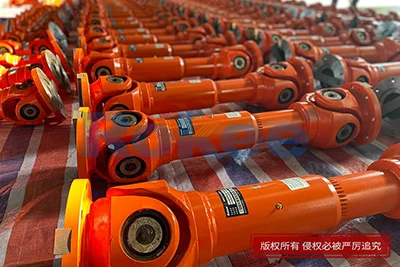

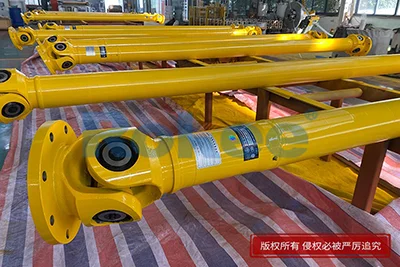
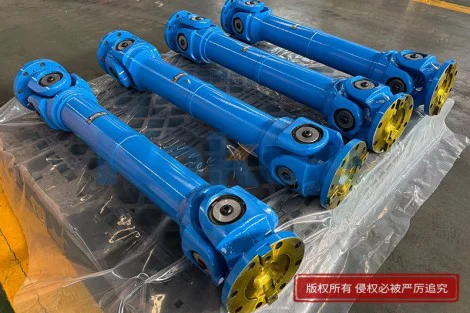
The formation of the working performance of the cardan joint drive shaft stems from its mature and scientific structural composition, and each component in the overall assembly has clear functional positioning and coordinated mechanical cooperation. The entire drive shaft system is mainly composed of cardan universal joints, a middle shaft body, telescopic spline structures, and connecting flanges, forming a complete closed-loop power transmission unit. The cardan universal joint is the core functional component that endows the drive shaft with adaptive compensation capabilities, and it is mainly assembled by symmetric joint yokes, a cross shaft, and precision bearing components. The cross shaft acts as the central hinge core, connecting the two groups of joint yokes in a mutually perpendicular spatial structure, allowing the connected parts to produce free angular deflection in multiple planes within a certain range. This special structural design breaks through the limitation of linear transmission of traditional rigid shafts, realizing flexible power transmission under non-linear working conditions.
The middle shaft body is the main bearing and torque transmission component of the entire assembly. It is usually made of high-strength alloy steel through precision forging and heat treatment processes such as carburizing and quenching. The optimized hollow shaft structure is widely adopted in mainstream designs, which effectively reduces the overall weight of the drive shaft while ensuring structural rigidity and torsional resistance. This structural improvement not only reduces the inertial resistance during mechanical operation and improves transmission efficiency but also avoids the vibration and noise problems caused by excessive weight of the transmission component during high-speed rotation. The surface of the shaft body is processed with precision finishing technology to ensure smooth rotation, reduce friction loss during operation, and extend the service life of the overall component.
The telescopic spline structure is another key functional part of the cardan joint drive shaft, which undertakes the important task of compensating for axial displacement during mechanical operation. In the actual working state, affected by road vibration, mechanical component deformation, thermal expansion and contraction, and dynamic position change of operating parts, the distance between the driving source and the driven load end often changes dynamically. The internal and external spline matching structure can realize free telescopic sliding within a safe stroke, effectively absorbing axial position errors and avoiding additional mechanical stress and component wear caused by rigid extrusion between transmission parts. The spline part adopts precision tooth profile processing to ensure tight matching and stable transmission, eliminating the power loss and jitter phenomenon caused by gaps during torque transmission.
The working principle of the cardan joint drive shaft follows the mechanical motion coordination law of articulated hinge transmission and dynamic displacement compensation. When the power source outputs rotational torque, the power is first transmitted to the input end flange of the drive shaft, and then stably transferred to the cross shaft assembly through the joint yoke. Relying on the rotational freedom of the cross shaft and the bearing set, the torque is continuously transmitted to the output end joint yoke and the middle shaft body, and finally delivered to the driven mechanical equipment. In this process, when the installation angle of the driving and driven shafts deviates or the operating angle changes dynamically, the universal joint hinge structure can automatically adapt to the angular change, ensuring that the torque transmission process is always continuous and stable without dead angles or power interruption. When axial displacement occurs between the two ends, the spline telescopic structure synchronously adjusts the overall length of the drive shaft to adapt to the dynamic change of the installation distance, realizing all-dimensional adaptive compensation of angle and displacement.
It is worth noting that a single cardan universal joint has the characteristic of periodic speed fluctuation during operation. When the two connected shafts have a certain deflection angle, the instantaneous angular velocity of the output shaft will produce regular changes with the rotation cycle, which may cause mechanical vibration and unstable transmission in high-speed and high-precision working scenarios. To solve this problem, most of the practical cardan joint drive shaft assemblies adopt a double universal joint symmetrical layout design. By arranging two universal joints at the two ends of the middle shaft body and reasonably matching the installation phase angle, the speed fluctuation generated by the single joint can be mutually offset. This optimized design fundamentally improves the uniformity of torque transmission, effectively suppresses mechanical vibration and running noise, and greatly enhances the operational stability and transmission accuracy of the drive shaft, enabling it to adapt to more complex and demanding working conditions.
Compared with other traditional transmission components such as rigid straight shafts and fixed couplings, the cardan joint drive shaft has outstanding comprehensive performance advantages in adaptive capacity, load resistance and application versatility. First of all, it has excellent multi-dimensional error compensation ability, which can simultaneously adapt to angular deflection, axial displacement and radial offset, and the maximum adaptive deflection angle of high-performance products can reach more than 25 degrees, which is far beyond the adaptive range of ordinary transmission components. This enables the mechanical system to maintain efficient power transmission even under severe working conditions of frequent vibration and dynamic position changes.
Secondly, the cardan joint drive shaft has strong load-bearing capacity and impact resistance. The overall structure adopts integrated forging and high-strength bearing configuration, which can withstand large torque and instantaneous impact load, and is not easy to deform or damage under heavy-load and intermittent working conditions. Its reliable structural stability ensures continuous and stable operation of mechanical equipment in high-intensity working scenarios. In addition, the component has high transmission efficiency, with the power transmission loss controlled within a very low range during operation. The optimized structural friction design and precision processing technology ensure that most of the power output by the power source can be effectively transmitted to the load end, reducing energy consumption and improving the overall operating efficiency of the mechanical system.
Moreover, the cardan joint drive shaft features simple assembly and strong maintainability. Its standardized modular structure is convenient for rapid installation, disassembly and replacement, and the daily maintenance process is relatively simple without complex debugging procedures. The structural design of separate wearing parts such as bearings and splines enables targeted replacement of damaged components, avoiding overall scrapping of the assembly, which effectively reduces the operating and maintenance cost of mechanical equipment in the whole life cycle. At the same time, the compact spatial structure of the drive shaft makes it suitable for installation in narrow mechanical spaces, with strong spatial adaptability and wide application compatibility.
Relying on the above superior performance, cardan joint drive shafts are widely applied in multiple industrial and transportation fields, becoming the core transmission guarantee for various mechanical equipment. In the field of road transportation, they are the key transmission components of rear-wheel drive and four-wheel drive vehicles, installed between the transmission and the drive axle. During the driving process of vehicles, the drive shaft can adapt to the up and down jump of the drive axle caused by uneven road surfaces and the angle change during steering, ensuring stable power output from the engine to the wheels, and realizing normal driving, acceleration and climbing of vehicles. It is widely used in passenger cars, commercial vehicles, engineering vehicles and special off-road vehicles, providing reliable power transmission support for vehicle power systems.
In the field of engineering machinery and industrial equipment, cardan joint drive shafts undertake the transmission work of various heavy-load mechanical systems. Large-scale engineering equipment such as excavators, loaders, cranes and pavers often face complex working conditions such as uneven bearing, frequent impact and violent vibration during operation. The excellent adaptive compensation performance and impact resistance of the drive shaft can fully adapt to the dynamic changes of these working conditions, ensuring the stable operation of the power transmission system of engineering machinery. In industrial production lines, it is applied to the transmission systems of conveyor equipment, mixing equipment, rolling machinery and other continuous operating equipment, realizing long-term stable power transmission and ensuring the continuous and efficient operation of industrial production.
In addition, cardan joint drive shafts also play an important role in agricultural machinery, ship machinery and special mechanical fields. Agricultural machinery such as tractors and harvesters usually operates in complex and harsh field environments, with large terrain fluctuations and severe equipment vibration. The drive shaft can adapt to the complex displacement and angle changes of agricultural machinery during operation, ensuring the normal output of mechanical power. In ship power systems, it is used for power transmission between ship engines and propulsion equipment, adapting to the vibration and displacement changes of ship equipment during navigation. In special fields such as aerospace equipment and precision testing machinery, high-precision customized cardan joint drive shafts are also applied to meet the high-precision and high-stability power transmission requirements of special equipment through optimized structural design and precision processing technology.
With the continuous progress of mechanical manufacturing technology and the continuous upgrading of industrial application requirements, the design and manufacturing technology of cardan joint drive shafts is also constantly innovating and optimizing. In terms of material technology, traditional ordinary carbon steel is gradually replaced by high-strength alloy steel, stainless steel and lightweight composite materials. The new materials have higher strength, better wear resistance and corrosion resistance, and can adapt to more extreme working environments such as high temperature, low temperature and humid corrosion. At the same time, the application of lightweight materials further reduces the self-weight of the drive shaft, improves the dynamic response speed of transmission, and reduces mechanical energy consumption.
In terms of processing technology, modern precision processing technologies such as CNC integrated processing, precision grinding and laser finishing are widely used in the production of drive shafts. The processing accuracy of key components such as cross shafts, joint yokes and splines is continuously improved, effectively reducing assembly gaps and friction loss, and further improving transmission stability and efficiency. In addition, heat treatment technologies such as integral quenching and local carburizing treatment optimize the mechanical properties of components, improving surface wear resistance and internal structural toughness, so that the drive shaft can maintain stable performance under long-term high-load operation and extend the service life significantly.
In terms of structural optimization, modern cardan joint drive shafts are developing towards high precision, low noise, high speed and long life. Through finite element simulation analysis, the structural stress distribution of the drive shaft is optimized, the local stress concentration problem is solved, and the structural fatigue resistance is improved. The optimized bearing sealing structure effectively prevents the entry of dust, moisture and impurities, avoids bearing wear and lubricant deterioration, and improves the environmental adaptability of the component. The low-vibration structural design suppresses resonance and noise generated during high-speed operation, making the drive shaft more suitable for high-precision and low-noise mechanical working scenarios.
Daily maintenance and scientific use are crucial to ensuring the long-term stable operation of the cardan joint drive shaft and extending its service life. In the working process, the drive shaft bears alternating torque, vibration load and friction wear for a long time, and improper use or lack of maintenance is easy to cause component wear, loose assembly, lubrication failure and other faults, affecting the transmission performance and even causing mechanical failure. In daily maintenance work, the most critical link is lubrication maintenance. The rotating hinge parts such as bearings and cross shafts need regular grease replenishment to ensure sufficient lubrication between friction pairs, reduce wear and avoid dry friction damage. The selection of lubricating grease should match the working temperature and load conditions to ensure good lubrication performance and stability in different working environments.
Regular inspection of the structural state of the drive shaft is also essential. It is necessary to regularly check whether the connecting flanges are loose, whether the shaft body has deformation, cracks and wear, and whether the spline telescopic part is smooth and stuck. For the bearings and hinge parts with serious wear, they should be replaced in a timely manner to avoid increased transmission gaps and unstable torque transmission. At the same time, check the sealing performance of the drive shaft assembly to prevent the aging and damage of the sealing ring from causing oil leakage and impurity entry, which will affect the internal operating state of the component. In the process of equipment use, avoid long-term overload operation and sudden extreme load impact, so as to prevent the drive shaft from producing irreversible deformation or structural fatigue damage.
In the face of the continuous development of modern mechanical equipment towards high speed, high load and high precision, the technical requirements for cardan joint drive shafts are also constantly improving. Future research and development directions will focus on intelligent optimization, lightweight design, extreme environment adaptation and long-life reliability. The combination of sensor monitoring technology and drive shaft structure will realize real-time monitoring of operating parameters such as torque, vibration and temperature of the drive shaft, realizing early warning of faults and predictive maintenance. The application of new lightweight high-strength materials will further reduce energy consumption and improve dynamic transmission performance. The optimized structural design and surface strengthening technology will enable the drive shaft to adapt to more extreme working conditions such as ultra-high temperature, ultra-low temperature and strong corrosion, and expand its application scope in high-end equipment and special fields.
In conclusion, the cardan joint drive shaft, as a classic and efficient flexible transmission component, relies on its unique articulated compensation structure, stable transmission performance and wide application adaptability, and has always occupied an irreplaceable core position in the field of mechanical transmission. From traditional transportation and industrial machinery to modern high-end intelligent equipment and special engineering fields, it provides basic power transmission guarantee for the operation of various mechanical systems. With the continuous innovation of material technology, processing technology and structural design, the comprehensive performance of cardan joint drive shafts will be further improved, adapting to the increasingly stringent working conditions and technical requirements of modern machinery, and continuing to contribute to the efficient and stable operation of various mechanical equipment and the development of modern mechanical engineering technology.
« Cardan Joint Drive Shafts » Update Date: 2026/7/15
URL: https://www.rokee.com/en/tags/CardanJointDriveShafts.html
Contact
If you require custom machined couplings, please contact Rokee via the contact information below for inquiries.
Email: Rokee@Rokee.com
 WeChat