Tire Shaft Couplings
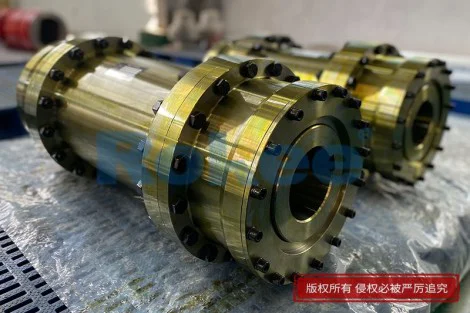
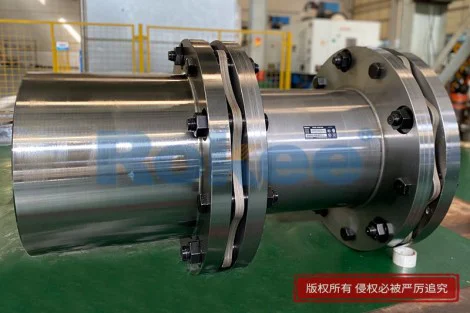
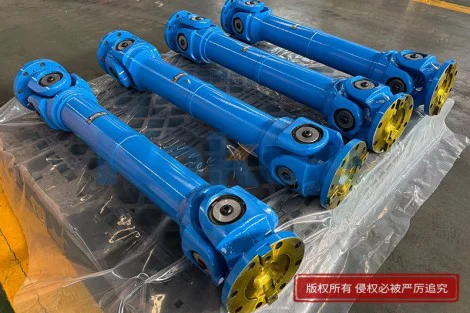
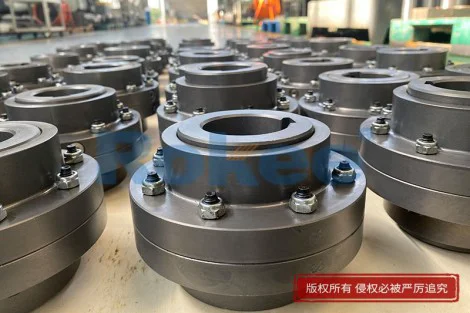
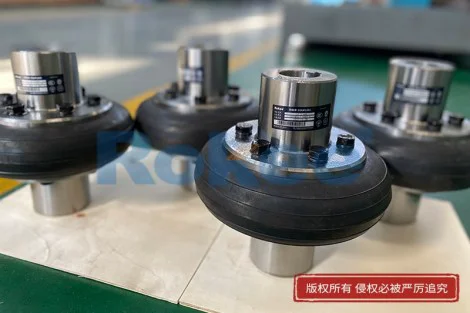
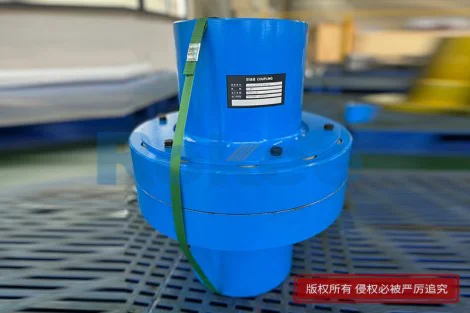
Rokee is a manufacturer of tire shaft couplings from china, we can provide non-standard custom tire shaft couplings based on parameters or drawings supplied by customers, with export support available.

Tire shaft couplings are highly versatile flexible transmission components widely applied in modern mechanical drive systems, designed to connect driving and driven shafts while delivering stable torque transmission under complex operating conditions. Distinguished by their unique tire-shaped elastic structure, these couplings stand out from traditional rigid and flexible coupling types with exceptional comprehensive performance in vibration damping, shock absorption, and misalignment compensation. The core structure consists of precision-machined metal flange hubs and reinforced elastic tire elements, which work in tandem to resolve common mechanical operation problems such as shaft position deviation, load fluctuation, and mechanical vibration. In industrial operation, minor installation errors, equipment aging, and thermal deformation inevitably cause shaft misalignment, which easily triggers equipment wear, noise, and transmission efficiency loss. Tire shaft couplings effectively mitigate these issues through the elastic deformation of rubber tire components, buffering instantaneous impact loads and isolating mechanical vibration. With simple structural logic, convenient assembly, and low operational maintenance demand, they adapt to variable load, cyclic operation, and frequent start-stop working scenarios, becoming a reliable transmission solution for general industrial machinery and medium-load drive equipment.
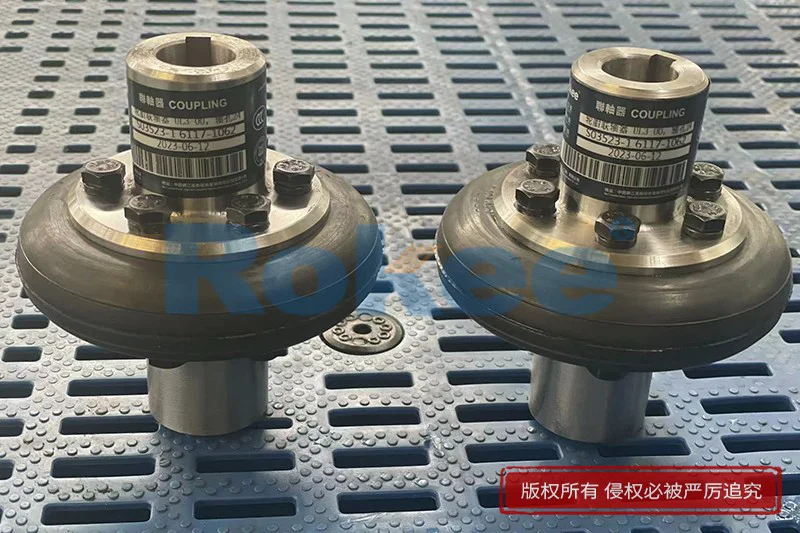
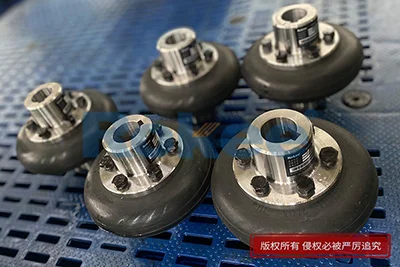
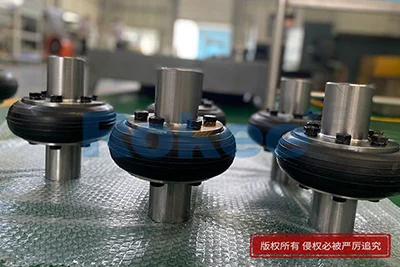
One of the most core and competitive performances of tire shaft couplings lies in their powerful multi-dimensional misalignment compensation capability, which solves the ubiquitous shaft matching problems in mechanical operation. In actual equipment assembly and long-term service, it is impossible to achieve absolute coaxiality between two connected shafts due to mechanical part manufacturing tolerances, manual installation deviations, equipment frame deformation, and thermal expansion and contraction during operation. These deviations are mainly divided into angular misalignment, radial parallel misalignment, and axial displacement, all of which will cause additional torque and friction in rigid transmission systems, accelerating component aging and failure. Tire shaft couplings rely on the flexible shear and tensile deformation of the elastic tire body to adapt to all three types of shaft misalignment simultaneously. The arc tire structure can freely adjust the stress angle according to angular deviation, offset radial position differences through overall elastic deformation, and tolerate axial stretching changes generated by equipment operation. This all-dimensional compensation function eliminates the need for ultra-precise shaft alignment during installation, reducing assembly difficulty and time cost, while automatically adapting to dynamic misalignment changes caused by equipment operation and environmental changes, ensuring continuous and stable torque transmission throughout the equipment service cycle.
Excellent vibration damping and shock absorption characteristics make tire couplings indispensable in high-fluctuation load working environments. Mechanical drive systems often face complex working conditions such as sudden start-stop, load sudden change, and forward and reverse rotation, which will generate instantaneous impact torque and high-frequency vibration inside the equipment. These impact forces and vibrations will directly act on shafts, bearings, and motors in rigid transmission systems, causing component fatigue wear, increased operating noise, and even short-term equipment failure. The elastic tire element of tire shaft couplings has good torsional flexibility and vibration isolation performance, which can effectively buffer and absorb instantaneous impact loads generated by load changes. When the system produces impact torque, the rubber tire body undergoes mild elastic deformation to consume impact energy, avoid rigid force transmission between shafts, and protect core transmission components from impact damage. Meanwhile, the multi-layer reinforced rubber structure can isolate most of the operating vibration generated by the driving end, prevent vibration transmission between adjacent equipment, reduce overall mechanical vibration amplitude, and create a stable operating environment for the entire drive system. This performance not only improves equipment operation smoothness but also effectively reduces mechanical noise pollution in industrial production sites.
Tire shaft couplings exhibit outstanding environmental adaptability and operational durability, enabling stable service in diverse and harsh industrial working conditions. The elastic tire materials adopted by qualified tire shaft couplings undergo special formula optimization, with excellent aging resistance, corrosion resistance, and temperature adaptability, resisting the erosion of conventional industrial media such as moisture, dust, and mild chemical gases. Unlike metal couplings that are prone to rust and corrosion or ordinary plastic elastic couplings that are easy to aging and brittle, tire shaft couplings can maintain stable elastic performance and structural integrity in long-term open-air, dusty, and humid working environments. Their structural design avoids vulnerable thin-walled parts and sharp stress concentration areas, with strong overall impact resistance and fatigue resistance, adapting to long-term cyclic operation and intermittent frequent start-stop working modes. In low-temperature environments, the optimized rubber formula can avoid hardening and elasticity attenuation, while in normal temperature continuous operation scenarios, it will not produce obvious creep deformation due to long-term load bearing. This excellent environmental adaptability expands their application scope, enabling reliable operation in various non-extreme harsh industrial scenes and effectively extending the overall service life of equipment transmission systems.
The installation and maintenance advantages of tire shaft couplings make them highly cost-effective in long-term industrial operation. Compared with other high-precision flexible couplings that require professional calibration tools and complex installation processes, tire shaft couplings feature a simple assembly process and low technical threshold. The modular split structure allows operators to complete shaft butt joint and fastening fixation through conventional tools, without ultra-precise coaxial calibration, greatly shortening equipment installation and debugging cycle. In terms of daily operation and maintenance, these couplings have extremely low daily maintenance costs, requiring no regular lubrication, oil replacement, or precision parameter calibration during the service period, eliminating the daily maintenance workload of transmission components. When local wear or elastic fatigue occurs to the tire element after long-term operation, users can directly replace the independent tire body without dismantling the connected driving and driven equipment or adjusting the shaft position, which greatly reduces equipment downtime and maintenance labor costs. The long service cycle of elastic components and zero daily maintenance characteristics effectively reduce the overall operating cost of mechanical systems, bringing significant economic benefits to continuous industrial production.
Tire shaft couplings cover a wide range of industrial application scenarios, matching the operational needs of most medium and low-speed mechanical transmission systems. They are widely used in general industrial equipment such as fans, pumps, compressors, and conveyors, which often have variable loads and continuous operating requirements. For fan and pump equipment with stable long-term operation and occasional load fluctuation, the vibration damping and misalignment compensation performance of tire shaft couplings can stabilize transmission efficiency and reduce equipment failure rates. In material conveying and processing equipment with frequent start-stop and alternating positive and negative operation, their excellent shock absorption performance can buffer frequent torque changes and protect equipment components. Additionally, they are also applicable to metallurgical, building materials, and general mechanical processing industries, adapting to medium-load, medium-speed drive systems with complex working conditions and frequent environmental changes. Although their structural characteristics limit their application in ultra-high-speed and ultra-heavy-load precision transmission scenarios, they can fully meet the operational standards of most conventional industrial mechanical systems, with extremely high scene compatibility and application flexibility.
With the continuous upgrading of modern industrial mechanical equipment, tire shaft couplings are also evolving in structural optimization and performance iteration to adapt to more diversified industrial needs. Current optimization directions mainly focus on improving the tensile strength and fatigue resistance of elastic tire materials, enhancing the stability of long-term high-load operation, and optimizing the internal cord layout to further improve multi-dimensional misalignment compensation accuracy and vibration damping efficiency. Meanwhile, the lightweight structural design is gradually applied to product iteration, reducing the overall weight of the coupling while ensuring transmission performance, lowering the rotational inertia of the transmission system, and improving equipment operation sensitivity. The reliable basic performance, convenient use characteristics, and wide scene adaptability determine that tire shaft couplings will always occupy an important position in the field of flexible mechanical transmission. As a mature and practical transmission component, they provide simple, efficient, and low-cost technical solutions for stable operation of various industrial mechanical systems, and their application value and market adaptability will continue to be highlighted with the development of intelligent and continuous industrial production.
« Tire Shaft Couplings » Update Date: 2026/8/5
URL: https://www.rokee.com/en/tags/tire-shaft-couplings.html
Contact
If you require custom machined couplings, please contact Rokee via the contact information below for inquiries.
Email: Rokee@Rokee.com
 WeChat