Types of Disc Membrane Couplings
Disc membrane couplings are essential flexible transmission components widely adopted in modern mechanical power systems, relying on the elastic deformation of metal disc membranes to transmit torque and compensate for shaft misalignment. As a core part of precision power transmission, they stand out from traditional rigid and elastic couplings due to their zero-clearance transmission, high fatigue resistance, and stable high-speed operation performance. These couplings feature a simple and reliable all-metal structure, free of rubber or plastic vulnerable parts, which endows them with excellent durability in harsh working environments such as high temperature, low temperature, and chemical corrosion. Classified by structural design, disc layout, connection mode, and functional characteristics, different types of disc membrane couplings cater to diverse industrial working conditions, ranging from light-duty precision transmission to heavy-load continuous operation. Each type has unique structural advantages, misalignment compensation capabilities, and application scopes, making targeted selection critical to improving mechanical transmission efficiency and extending equipment service life.

Single disc membrane couplings represent the most basic and compact structural form among all disc membrane coupling types, consisting of a single set of stacked metal disc membranes connected between two shaft hubs with high-strength fasteners. The entire assembly eliminates redundant structural components, achieving an ultra-light and space-saving layout that fits well in mechanical systems with limited axial installation space. Driven by torque transmission, the single disc pack generates uniform elastic deformation to accommodate minor angular, axial, and radial misalignments between connected shafts, ensuring continuous and stable power output without transmission clearance. Thanks to its simplified structure, this coupling type requires minimal manufacturing processes, reducing structural failure points and improving overall operational stability. It delivers outstanding dynamic balance performance during medium and high-speed rotation, effectively suppressing vibration and noise generated by shaft offset. Although its load-bearing capacity and misalignment compensation range are relatively limited compared with multi-disc structures, it fully meets the operational needs of light-duty precision equipment. Common application scenarios include small precision pumps, miniature transmission motors, office automation machinery, and low-torque servo systems, where its compact size and reliable precision transmission create distinct practical advantages.
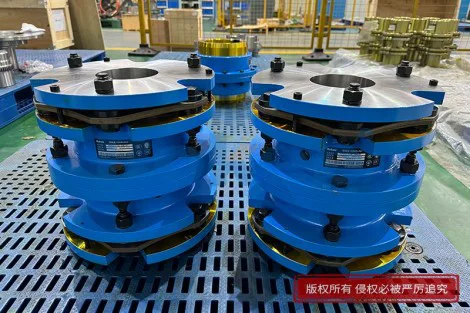
Double disc membrane couplings are evolved from single disc structures with an additional independent disc pack and intermediate spacer sleeve, forming a dual-flexible transmission structure that greatly optimizes misalignment compensation performance. The two sets of disc membranes are symmetrically distributed on both sides of the spacer sleeve, working in tandem to bear torque and absorb multi-dimensional shaft misalignment, which significantly improves the allowable range of angular and radial offset compared with single disc designs. The intermediate spacer not only separates the two flexible units but also enhances the overall structural rigidity of the coupling, enabling it to withstand larger torque loads while maintaining excellent flexibility. This structural design effectively reduces the stress concentration of a single disc pack during long-term operation, greatly improving fatigue resistance and service life under continuous cyclic working conditions. In terms of operational performance, double disc membrane couplings maintain zero-clearance synchronous transmission at high speeds, with better vibration damping effects than single disc models. They are widely applicable to medium-load industrial equipment, including medium-sized water pumps, fan transmission systems, general industrial reducers, and medium-power servo transmission devices, balancing structural flexibility and load-bearing capacity to adapt to most conventional industrial transmission scenarios.
Multi-link disc membrane couplings are a specialized structural type designed for high-torque and high-stability transmission scenarios, distinguished by their multi-group discrete disc link layout instead of integrated disc packs. The coupling is composed of multiple independent disc membrane links evenly distributed along the circumferential direction, with each link independently participating in torque transmission and misalignment compensation. This discrete structural design disperses the overall load on a single disc membrane, effectively reducing unit stress and avoiding local deformation or damage under heavy-load working conditions. The number of disc links can be adjusted according to actual load demands, forming flexible configuration schemes to adapt to different torque levels. During operation, the multi-link structure produces coordinated elastic deformation, achieving more uniform force distribution and higher transmission stability than integrated disc structures. Additionally, this type of coupling features strong anti-fatigue performance and can withstand long-term intermittent impact loads and cyclic torque changes. It performs excellently in high-power industrial equipment such as large industrial fans, heavy-duty conveyor systems, industrial compressor units, and high-power mechanical transmission hosts, providing stable and reliable power transmission support for heavy-load continuous production equipment.
Integrated disc membrane couplings adopt an integral stamping and forming process for the core disc membrane component, with no splicing or assembly gaps in the disc structure, forming a fully integrated flexible transmission unit. Different from assembled disc couplings, the integrated design eliminates assembly errors between multiple disc components, achieving higher dimensional accuracy and transmission synchronization. The integrated disc membrane has uniform material thickness and structural rigidity, enabling extremely stable elastic deformation during torque transmission, with no local stress mutation or uneven deformation. This structural feature makes it excel in ultra-precision transmission scenarios that require strict motion accuracy, effectively ensuring zero phase difference and zero clearance power transmission. Moreover, the integral structure has better sealing performance and dustproof capability, as it avoids assembly gaps that may accumulate dust, impurities, or lubricating oil dirt. It also shows excellent stability in high-speed rotating states, with lower dynamic unbalance and smaller vibration amplitude. It is mainly used in high-precision mechanical equipment such as precision machine tool transmission systems, industrial robot joint drives, high-speed testing instruments, and precision aerospace auxiliary transmission mechanisms, where ultra-high transmission accuracy and operational stability are required.
Bolt-fixed disc membrane couplings are classified by connection mode, adopting through-bolt fastening to fix disc membranes and hubs as a whole, which is one of the most mainstream connection structures in disc membrane couplings. The high-strength bolts penetrate the reserved holes of the disc pack and hub flanges, achieving rigid connection and reliable torque transmission through pre-tightening force. This connection method features high structural firmness and strong anti-loosening ability, which can effectively resist torque impact and mechanical vibration during long-term equipment operation, avoiding connection looseness or transmission failure. The bolt-fixed structure allows for standardized disassembly and assembly, facilitating daily maintenance, component replacement, and equipment debugging without damaging the core disc membrane components. In terms of performance, this coupling type has stable torque transmission efficiency and good adaptability to medium and high-load working conditions. It can maintain stable connection performance under alternating temperature and vibration environments, with strong environmental adaptability. It is widely applied in general industrial machinery, petrochemical transmission equipment, power machinery, and conventional automated production lines, serving as a versatile and reliable transmission component for most standard industrial scenarios.
Interference-fitted disc membrane couplings adopt an interference assembly method between the coupling hub and the transmission shaft, abandoning traditional bolt connection for shaft positioning, and rely on the elastic extrusion force between components to achieve torque transmission and fixed positioning. The core advantage of this design is the complete elimination of connection gaps at the shaft end, realizing ultra-high-precision synchronous transmission without any relative sliding or phase deviation during operation. The interference fit structure optimizes the axial and radial dimensional compactness of the coupling, making the overall structure more concise and neat, and avoiding the protruding bolts that may cause wind resistance and vibration in high-speed operation. This coupling type has excellent dynamic balance performance, suitable for ultra-high-speed rotating equipment that puts forward strict requirements on rotational stability. Meanwhile, the integrated interference connection has better anti-fatigue and anti-vibration capabilities, not prone to loose positioning after long-term high-speed operation. Due to its high assembly precision and stable positioning performance, it is mostly used in high-speed precision equipment such as high-speed centrifugal equipment, precision motor spindles, high-speed turbine auxiliary systems, and ultra-precision rotating machinery, meeting the extreme precision and stability demands of high-speed transmission scenarios.
Spacer-type disc membrane couplings are equipped with detachable intermediate spacer components on the basis of double disc structures, specially designed for long-distance shaft transmission scenarios where the two connected shafts have large axial spacing. The independent spacer sleeve can be customized in length according to the actual shaft spacing demand, flexibly adapting to various long-span transmission layouts without changing the core disc membrane structure. The spacer component maintains the parallelism and coaxiality of the two sets of disc packs, ensuring balanced force on the flexible units during torque transmission and avoiding eccentric wear caused by long-span transmission. This structural design greatly enhances the axial misalignment compensation capability of the coupling, and can effectively absorb axial displacement caused by equipment thermal expansion, installation errors, and long-term mechanical wear. In addition, the spacer structure separates the two flexible disc packs, reducing mutual interference during deformation and improving the overall operational stability of the coupling. The detachable design also facilitates equipment maintenance, allowing independent disassembly and replacement of the spacer or disc pack without moving the main equipment. It is widely used in long-span transmission systems such as large mechanical transmission supports, remote power delivery equipment, industrial pipeline pump groups, and large-scale mechanical assembly lines, solving the transmission difficulties of long-distance shaft connection.
Tags: Membrane Couplings , Flexible Membrane Couplings , Disc Membrane Couplings , Flexible Laminated Membrane Coupling , sandwich panel machine , pu sandwich panel line
« Types of Disc Membrane Couplings » Update Date: 2026/8/13
URL: https://www.rokee.com/en/blog/types-of-disc-membrane-couplings.html
Contact
If you require custom machined couplings, please contact Rokee via the contact information below for inquiries.
Email: Rokee@Rokee.com
 WeChat