Steel Plate Flexible Couplings Supplier
Steel plate flexible couplings have emerged as indispensable core components in modern industrial power transmission systems, serving as a critical connecting medium for mechanical shaft systems across diverse industrial scenarios. Featuring unique metal elastic deformation working mechanisms, these couplings effectively connect driving and driven shafts while efficiently compensating for various shaft misalignments generated during equipment operation, including axial, radial, and angular deviations. Unlike rigid coupling products that lack adaptive adjustment capabilities, steel plate flexible couplings integrate high transmission stability, excellent vibration damping performance and durable structural reliability, making them widely applicable in high-speed, high-precision and heavy-duty mechanical equipment. Professional suppliers focus on optimizing structural design, material selection and production craftsmanship of such couplings, aiming to deliver high-performance transmission solutions that reduce equipment operating failures, extend mechanical service life and improve overall operational efficiency for industrial production systems.

The fundamental working principle of steel plate flexible couplings relies on the controllable elastic deformation of stacked stainless steel plate groups, which differentiates them from traditional flexible coupling types that depend on rubber or spring deformation. During equipment operation, torque is stably transmitted from the driving shaft to the driven shaft through the micro elastic torsion, stretching and bending deformation of steel plates within the material’s elastic limit. When mechanical operation produces installation deviations, thermal expansion displacement or operational vibration-induced shaft misalignment, the multi-layer steel plate structure can adaptively adjust its deformation state to offset displacement errors, avoiding rigid stress concentration between shafts. This pure metal elastic transmission mode eliminates the aging, fatigue and failure risks of non-metal flexible materials, ensuring continuous and stable torque output for long-term cyclic operation. Moreover, the uniform stress distribution of steel plates effectively reduces transmission hysteresis, realizing zero-backlash power transmission that meets the high-precision operation requirements of sophisticated mechanical equipment.
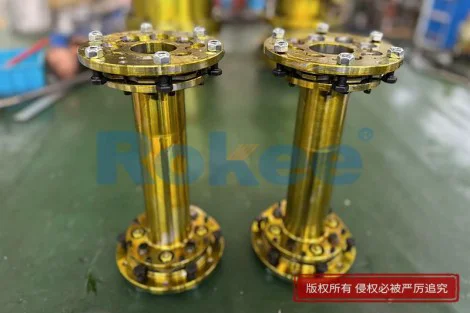
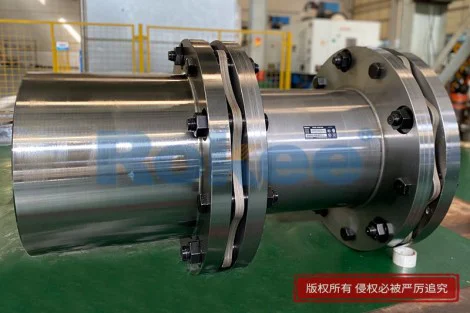
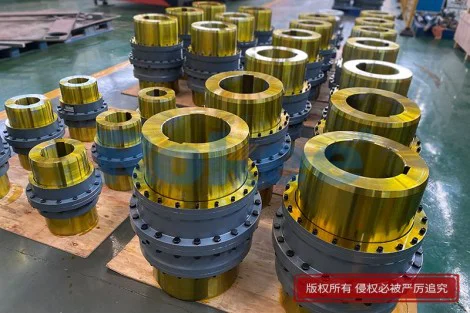
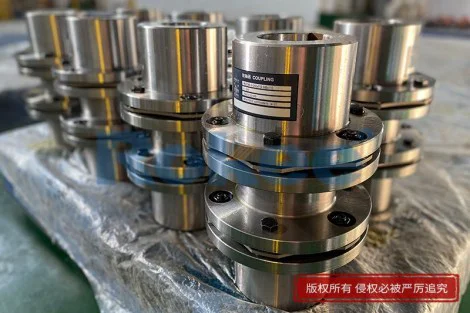
Structural composition design is the core advantage of high-quality steel plate flexible couplings, with mature and optimized configurations formed through long-term technical iteration. The complete coupling structure mainly consists of precision-processed steel plate groups, high-strength fastening components and symmetric half-coupling bodies. The steel plate groups adopt multi-layer stacked thin-plate structures, which balance flexibility for deformation compensation and overall structural rigidity for torque transmission. All steel plates undergo fine polishing and precision cutting to ensure consistent thickness and uniform force bearing, preventing local stress overload during operation. High-strength bolts are used for circumferential fastening, fixing the steel plate groups firmly between two half-couplings to avoid relative displacement and loosening during high-speed rotation. The overall compact structure saves installation space, simplifies assembly and disassembly processes, and facilitates daily maintenance and equipment overhaul without complex professional operations, greatly improving the convenience of industrial equipment operation and maintenance.
Material selection directly determines the service performance and service life of steel plate flexible couplings, and professional suppliers always adhere to strict material screening standards to guarantee product quality. High-grade stainless steel is the mainstream core material for manufacturing coupling steel plates, featuring excellent tensile strength, elastic stability and fatigue resistance. This material can maintain stable elastic deformation performance under long-term high-frequency cyclic operation, avoiding permanent deformation or material fatigue failure. In addition, the selected steel materials have outstanding oxidation resistance and corrosion resistance, enabling the couplings to adapt to complex industrial environments with moisture, dust and trace corrosive media. Fastening accessories are made of high-strength alloy materials, which can resist shear force and tensile force generated by high torque transmission, ensuring the structural stability of the whole coupling. Scientific material matching effectively avoids performance attenuation caused by material defects, realizing long-term trouble-free operation of the coupling in various working conditions.
Steel plate flexible couplings possess superior environmental adaptability, enabling stable operation in various harsh and complex industrial working environments, which is one of the key reasons for their wide industrial popularity. Different from rubber flexible couplings that are sensitive to temperature and chemical environments, all-metal structural couplings can adapt to a wide temperature range without performance degradation. They can maintain normal transmission efficiency in high-temperature working scenarios such as industrial heating equipment, power generation equipment and high-load operating units, and also operate stably in low-temperature environments of refrigeration and cryogenic processing equipment. Meanwhile, the metal structure is not prone to aging, cracking or deformation under the influence of ultraviolet rays, humidity and industrial dust, and can resist mild chemical corrosion from industrial flue gas and liquid media. This excellent environmental adaptability greatly reduces the limitation of equipment installation and use scenarios, and improves the reliability of mechanical transmission systems in diversified production environments.
Vibration damping and noise reduction performance endows steel plate flexible couplings with unique application value in high-precision and low-noise industrial equipment. During the operation of mechanical transmission systems, equipment startup, load fluctuation and shaft misalignment will inevitably generate vibration and impact force, which will be directly transmitted to the whole equipment through rigid connections, causing component wear, loose parts and increased operating noise. The flexible steel plate structure can effectively absorb and buffer vibration and impact energy generated in the transmission process, weaken vibration transmission between driving and driven shafts, and reduce the operating load of equipment bearings and other core components. This vibration suppression effect not only reduces mechanical operating noise and improves the on-site industrial operation environment, but also avoids component abrasion and fatigue damage caused by long-term vibration, effectively reducing equipment failure rates and maintenance costs, and improving the overall stability and comfort of equipment operation.
Steel plate flexible couplings cover a wide range of industrial application scenarios, fully meeting the differentiated power transmission demands of various mechanical equipment. In heavy industrial fields such as compressors, turbines and large motor units, they undertake high-torque and high-speed transmission tasks, stabilizing shaft system operation and avoiding transmission failure caused by load fluctuation. In industrial supporting equipment such as large fans, pumps and transmission pipelines, they compensate for shaft displacement errors caused by equipment operation and environmental temperature changes, ensuring continuous and efficient equipment operation. In precision manufacturing fields including automated production lines and robotic transmission systems, their zero-backlash and high-precision transmission characteristics guarantee micron-level motion accuracy, supporting precise operation of sophisticated processing equipment. In addition, they are also widely used in metallurgy, chemical industry, building materials and other industries, becoming a universal and reliable transmission component for modern industrial mechanical systems.
Professional steel plate flexible coupling suppliers focus on technological optimization and product iteration, continuously improving product comprehensive performance to adapt to the upgrading demands of modern industrial equipment. Mature suppliers have complete production and processing systems, adopting precision processing equipment and standardized production processes to control every production link from material cutting, plate forming, precision polishing to assembly testing. They focus on optimizing the steel plate layout and structural stress design, improving the displacement compensation capability and torque transmission efficiency of products while reducing structural wear and energy consumption. At the same time, professional suppliers provide customized design services according to different equipment operating conditions, adjusting structural parameters to match diversified working demands. With reliable product quality, stable performance and professional supporting services, high-quality suppliers provide solid component support for the stable operation and efficient upgrading of global industrial transmission systems.
Tags: Plate Couplings , Flexible Plate Couplings , Steel Plate Flexible Coupling , sandwich panel machine , pu sandwich panel line
« Steel Plate Flexible Couplings Supplier » Update Date: 2026/9/1
URL: https://www.rokee.com/en/blog/steel-plate-flexible-couplings-supplier.html
Contact
If you require custom machined couplings, please contact Rokee via the contact information below for inquiries.
Email: Rokee@Rokee.com
 WeChat